Showing posts with label Teaching. Show all posts

Tuesday, March 26, 2013

This house believes that debate is a valuable teaching/learning tool.

I have spent most of my time and energy since January preparing Tajik students to debate in English. 

I must first admit that I used to be prejudiced against debaters. Though I enjoyed debates as a class activity - to learn about the creation of Israel, for example - I am generally conflict-adverse, and it seemed that debate emphasized conflict, and seemed to feature too much of that teenage-male certainty that they are right about everything.

I am glad to report that I have changed my views. I not only think that debate is a great tool to use in a classroom, but also in extracurricular practice and competition. In preparing my students - both school-age and university - I have realized that the tools of a good debater are important tools for success in other arenas as well.  When a friend and I gave a presentation about using debate during our conference in Nepal, we started by talking about the various reasons we chose to start debate clubs. 

Students first came in order to practice English speaking skills. They desperately want practice speaking in English and they don't get that in their school or university English classes. I have had the pleasure of seeing a few of my debaters turn from shy, stuttering speakers who could hardly continue for 30 seconds into confident first speakers who can present their ideas for 6 minutes (plus three minutes answering questions). Obviously this involves not only English language skills but also the art of public speaking. For one girl who would only look at the floor, I moved around an American flag so she would look up (even if not at our faces). The group I have been working with has a ways to go, but is much more confident. 


Debating is an accessible way to approach controversial subjects, and to practice critical thinking. In the words of the International Debate Education Association, whose website we plunder extensively for ideas, 
Debate is an essential tool for developing and maintaining democracy and open societies. More than a mere verbal or performance skill, debate embodies the ideals of reasoned argument, tolerance for diverging points of view, and rigorous self-examination.  
I have seen my patience rewarded as my students have slowly moved towards these ideals. Students don't often get a chance to express their own opinions in the educational system here. We have moved from circular, non-arguments like "it is good because it is the law" or "because it is" to actual arguments in defense of a position that they may not agree with. I banned the use of the phrases "right" and "wrong" in order to move towards logical reasoning. We worked through the ideas that you are not expressing your own opinions and it is not personal - it is about ideas, and how well they are expressed. I think some of them finally understood this in our first competition when a team with better English skills lost to one with much better arguments.  I have repeated many times that debate is about respect: respecting your opponents.

As someone who teaches writing it is also satisfying to see that those same debating skills are ones that students could apply to writing: a clear introduction, outline, evidence and examples, and conclusion. They must do research. They must plan ahead. These are also foreign skills for most of them, and I love to see that it is the same process of thinking that will serve them well in writing.


Now that we have prepared and participated in two tournaments [see many more photos from the first tournament and photos from the second tournament], it is also heart-warming to see the camaraderie and friendship that have built up between students of different ages. The winners of the first tournament were a woman in her mid-20s who graduated from university with a law degree, a fourth-year university student in telecommunications, and an 11th-grade boy. At the second tournament, I inadvertently become a matchmaker in putting together the members of one of the teams.


I enjoyed organizing the tournaments; I remembered that I like producing events, and my experience producing theater shows at Yale served me well.  But I still don't like conflict, and I don't like judging. I would much rather guide the preparation process. I care too much to be a passive audience member; I was tense watching my students and waiting to see who won (and I was a bit crushed when a group lost that I thought should have won). We were lucky enough to have guest judges who would be impartial. As Sarah pointed out, one of the coolest things about these competitions is that they were fair, as opposed to many competitions here, which everyone knows are rigged because of a relative or where you are from or some other factor. 


The students were extra-excited at the second competition because the winning debaters would get the opportunity to debate in Dushanbe. My Dushanbe counterpart has been organizing a National English-language Debate tournament there, and flurries of emails have been flying back and forth about every aspect of the tournament. It is finally happening this coming weekend, and Sarah and I will go with the debaters to help manage and judge the three-day tournament. 


Also exciting, but less tangible and looking less likely, is that we have the opportunity to send some high school students to the Asia Youth Forum, a two-week debate tournament/seminar for school students all over Asia, which is taking place in Kyrgyzstan this year, near Lake Issyk-kul. This would be an amazing opportunity to learn infinitely more than I could ever teach about debate and meet peers from dozens of countries. But the scholarship process has left us in the dark, and it is still unclear what will happen.

More than the competitions, though, training these students has given me the opportunity to spend more time with them. I have gotten to see them think and talk and worry and then go out to lunch with some of them and talk more outside of the confines of debate. I am excited to meet more debaters in Dushanbe this weekend, but for me this national tournament is less important than the work that we have already done in Khujand. I am proud of all of the debaters I have been working with.


More information about training a debate team and many sample debates at idebate.org.

Tuesday, February 12, 2013

A Five-Paragraph Essay in Response to the Question I am Asked Everywhere in Tajikistan


Dedicated to the people I am teaching to write essays. (Universities here focus on translation and oral exams rather than writing, so thesis statements and topic sentences are mostly new ideas.) 

Whether in a taxi or at a university, whenever I meet people in Tajikistan, they are invariably eager to ask questions. Most have never met an American in person, and want to find out whether their ideas about America are correct, and what my corresponding ideas about Tajikistan are. They are particularly excited that I can speak Tajik, although at times the conversation gets confusing when I do not understand what they have asked, and instead answer from my mental list of expected queries. These interactions, I sometimes think, are more important than my formal teaching here. So this is my response to the most important question: yes, I do like Tajikistan, because of the great natural beauty, the hospitable people, and the opportunities to learn.

Outline, on ХГУ notepaper.
My first impression of Tajikistan was from photos of the mountains and rivers, and I thought that it was beautiful and that I wanted to go. Since arriving in the summer of 2011 and again in the fall of 2012, those pictures have been surpassed by my own awe at the 93% mountainous country, both in Badakhshan and in Sughd. I admire the peaks of the mountains that frame Khujand, as well as the valley's water features: the Syr Darya ("Secret River") and the Kairakkum Reservoir (the "Tajik Sea"). I cannot wait for the spring, when the mountains will spring up in green and the trees will blossom. The fruits of those flowers are sweet, juicy, and endless: apricots, peaches, figs, mulberries, apples, pears, pomegranates, persimmons, and more. These delicious fruits take over my kitchen and fill my stomach in many forms. Whether in tasting or viewing, in Khujand or Khorog, the natural wonders of Tajikistan make every short trip a chance to see and taste something amazing.

Not only is Tajikistan's nature worth experiencing, but also the kindness and generosity of its people. Tajik people treat me not as a foreigner, but as a guest. The questions about my well-being are underscored by concern that I have been treated as a guest ought to be. "Come to my house for tea," they say. "I will make you plov." "Thank you, thank you," I reply, and even though I do not go to most of those houses, it is the earnest offer that is special. Every culture has a parable about welcoming guests, but Tajik culture fulfills this universal value in a way that is not universal. In America we are taught to think about our own grades, our own profession, our own close circle. Tajik culture teaches people to be more generous, and to spread that care beyond yourself to others, whether as a host or as a guest. This teaches me to think more about others, and also makes my time here so pleasant, since everyone is always eager to welcome me. 

Draft, with edits.
The people in Tajikistan welcome me enthusiastically, and also make every interaction a source of new information about history, culture, or language. I talk with people around a dastarkhan and they tell me about the three-day invasion of Khujand just after the Civil War. I teach an English class about Halloween and trick-or-treating in America, and I learn about Navruz and boichechak. I think that "archa" means "New Year's Tree," and then I learn from following a six-year-old around a park that it actually means "evergreen." Though I can read about history, culture and the Tajik language in books, it is through meeting people that I learn. 

My experience in Tajikistan is the sum of more than learning, people, and nature, but together they provide a good beginning to answer what I most appreciate about this place. And once I have begun, they can continue: "Do you like plov?" "Are you married?" "I will find you a Tajik husband." "What is your work?" I reply with invitations to the American Corner and my own questions: "How many children do you have?" "When did he leave for Russia?" "What is that called?".  The conversation ends with one or both of the pleasantries that do not mean goodbye, exactly, but well wishing. The first is хуш омадед (khosh omaded), which literally means "(your) good coming,"and is translated in dictionaries as "welcome," though they say it both when you arrive and when you leave. The other is саломат бошед (salomat boshed), which means "be healthy," and is added at the end of any store interaction or conversation. So: хуш омадед, саломат бошед. 

Thursday, January 24, 2013

Five Months


On Sunday I submitted my Mid-Year Report, which is required of all Fulbright grantees half-way through their grant period. Which means that it has been five months since I landed in Dushanbe, and now there are less than five months left. All of a sudden, ten months seems not long at all, and I realize that I will soon be one of the Sharons and Davids that people here remember coming and leaving. 

Marking January 1st - while fun - was not as meaningful to me. I still measure my life in school years. If I am to measure by calendar year, then I should be reflecting on all of 2012: writing my senior essay and hanging out in our common room and graduating and the Cove and Tajikistan. It is a colorful and exciting collage, but not a cohesive whole. Rather than making New Year's Resolutions, I have made Fulbright Resolutions, or perhaps Fulbright Realizations: what I have realized since August 20, and what I plan to realize by June 13, when I fly back to the U.S.  

My Fulbright Renewals are the result not only of realizing I am half-way, but also the result of returning after a month of traveling. First to Nepal, then return-trip detour to Almaty, then back in Khujand for a week of winter, then to Italy, where I met my family and celebrated Christmas. I arrived again in Dushanbe on New Year's Eve and came back to Khujand three days later when my baggage arrived. 

I was met at the American Corner by a flurry of students finishing their applications for the Global UGrad progam. I was swept into essay-reading and turning away reference requests. In the three weeks since, I have made myself much busier than I was September-November. I now have morning classes, instead of lazy planning sessions. One is my new series of TOEFL preparation trainings (the American Corner as a Public Organization is not legally qualified to teach 'classes,' only provide 'trainings'). That involved a sign-up, a test to scare people away, and fighting away late-comers. I also have a "Reading Club" (read-aloud time) and a Hunger Games book club. I am teaching an advanced writing workshop (we are working on essays, starting with a biography - think middle school). I am trying to start a competitive debate club, rather than my open-to-all debate/ activity/ discussions. I have had extra classes with visiting groups of 30 kids each from two different nearby towns. I have put a lot of time into thinking about how to teach about Martin Luther King, Jr. and the inauguration.

I have benefited from taking to heart another ETA's self-identification as an after-school programmer rather than a teacher. Extracurricular is a better word: you cannot be 'after school' if there is no school. The government declared there would be no school in January this year because it was supposed to be too cold to heat classrooms - something that does not happen every year, but did happen last year. University students are either in exams or on break. The American Corner is crowded. 

This means I come home more tired and stay up late planning - but now I have real coffee to help me get up in the mornings. And when I am teaching, I am moving and thus warmer than sitting in one place. 

January has been milder than (the one week I saw of) December, but it is still cold. My winter wardrobe includes a scarf every day - worn tied behind my head with the ends hanging - plus leggings, pants, turtleneck, sweater, coat, gloves. All of those are worn inside as well as outside. It used to include black boots, but the heel broke and I haven't had time to take it to the cobblers at the bazaar (they fixed both zippers on the same boots for 5 somoni). 

Our water is not the most reliable: pipes have frozen twice, and the pump stopped working once, but now it just ebbs and flows throughout the day so sometimes we have to turn on the pump to get any warm water or even to get enough to wash the dishes. 

I eat a lot of soup. I made some delicious braised cabbage this week. I try to remember to get vitamins somehow, even though vegetable selection is sparse and I forget about the fruit when it is not shoved at me (apples are now 7 somoni a kilo instead of 1 somoni/free in buckets in the fall). I drink a lot of honey-and-lemon. Lemons here are large and sweet and more lemon-y. 

More plans to realize: See a game of buzkashi. Celebrate Navruz exuberantly. Go hiking. Use my binoculars and my new Guide to the Birds of Central Asia. Try to learn more Tajik music. Actually study Tajik vocab. Spend more time with people. 

The hardest questions for me to answer in my mid-year report were in the "Cultural and Social Adjustment" section. 
  1. What were your strategies for getting acquainted with the people and the culture? 
  2. What kind of changes did you make in order to adjust to the local culture?  

"Were," "did;" do they mean that my adjusting is all in the past? I am comfortable here, and I think I often know what to expect, so in that sense, yes. But while I might be "adjusted," I am merely "acquainted" with people and culture, and I agree - I do not feel that I know much of anything. I ended up answering in the past tense what I was really meant as directions to my future self for the rest of my time: Be available and present with people.  Listen more than I talk. Work on figuring out when and how to hang out with people. Continue trying to figure out everything.

Friday, January 18, 2013

Mice


Mice are usually good at hiding, and yet recently they have been scurrying their way into my life. Not live ones, luckily; though I do think they can be cute, I had most of my sympathy driven out of my vegetarian heart when part of my job at summer camp was to be "Mousketeer" and set traps to catch the rodents that ate holes in our clothes and threatened the kitchen. I do not welcome them inside, and our apartment here has proven rodent-proof. That does not mean that my heart is hardened to fictional mice.

I have started a new "Reading Club" at the American Corner: I inherited one when I first arrived that became frustrating, since I had to figure out what to read and how much to print since new people would come every time and I wouldn't know how many and what level they would be. So I canceled it, since that is the wonderful prerogative of my position. But at the conference in Nepal, our main presenter emphasized that she believes that reading aloud helps students at all levels. New research supports reading aloud to ESL/EFL students because they can listen to correct pronunciation, not worry about comprehending every word, and understand more than when they try to read aloud themselves (I know I experience this: when I read aloud in a foreign language, I focus on words and my brain cannot also focus on meaning; I have to either read it quietly before or after). I seized upon this suggestion, and decided it could stand on its own. Read-aloud story time in libraries is a time-honored American Library Tradition. And the American Corner is in a Library. And we are all about teaching American Traditions. Most importantly, I really enjoy reading aloud.

I looked through our collection of lower-level books, and considered something like Old Yeller or Sarah Plain and Tall, but settled on The Tale of Despereaux by Kate DiCamillo. It is a recent children's classic and winner of the Newbery Medal in 2004. I was a little older than its target demographic when it was published, but my mother bought it for my younger brother, and I was taken by the hardcover's soft-pastel drawing and the pages' deckled edges, and quickly swallowed the story of the mouse who falls in love with a human princess. I didn't really remember the plot when I picked it off the shelf at the American Corner for consideration, but its fate was sealed when I found a PDF teachers' guide that advertised using it in a class for ESL students, as well as parents' reviews that said it seemed to be written as a read-aloud novel. Participants at the American Corner have now learned the words "scurry" and "despair." [If you would like to learn a new word, mouse in Tajiki is муш (mush), which is comfortingly close to English, but a bit cuter-sounding.] They are still figuring out the graphic organizers I have given them (they didn't seem to want to draw). But I am excited to reach the second section next week, when we learn that the king has banished soup from the kingdom due to a series of events involving a rat. There is true despair in the kingdom over this - and there would be here, too, because soup is an important staple of the Tajik diet (I know a Tajik girl who went to the U.S. for university and wrote home asking for soup recipes to make in the dorm kitchen because she was homesick for soup and couldn't find any).

I took several books from the shelves of the American Corner; one night I read The Tale of Desperaux in bed, and the next I read Maus, Art Spiegelman's graphic novel about the Holocaust. Both have careful illustrations, but the latter took my breath away from darkness rather than light. I had always wanted to read it and was recently reminded of its existence when the ELF in Almaty told me she is using it in her university English classes. So it caught my eye when I saw it here. We have a fairly random collection of books that are mostly too advanced or too specialized for most of the people who come to the American Corner, like 400-page biographies of Benjamin Franklin, or to a book by Julia Alvarez co-written with her husband Bill Eichner

But this week Christmas came in the form of hundreds of new books - from Scholastic! It was like book orders in middle school, only many times better - and many times heavier. Several people waited for the truck on Monday, but by the time it arrived there were only five of us left, and it took over two hours to carry all of the them up to the fourth floor of the library in the dark. I carried books, and the boys paired off to carry the new shelves and tables. We still don't exactly know what's in all of the boxes, since the embassy ordered them, but we understand that they are easy books more appropriate for people just learning English, and I cannot wait to find out (maybe Stuart Little is there?). We have managed to investigate the one large box of DVDs, which included many good movies, but I was most excited about An American Tail.

Sarah and I have been talking about showing this movie since September, when we realized that it would be a great way to discuss what it means to be an immigrant and temper the mania for visa requests. It is about the trials of a Jewish-Russian immigrant family to New York in 1885, from getting separated from family to being swindled by rats who take advantage of recent arrivals. And, yes, these characters are also mice. (Wikipedia informed me that Art Spiegelman thought director Stephen Spielberg plagiarized his idea, but decided not to sue.) Before arriving, the family is certain that "There are no cats in America/ and the streets are paved with cheese!", but, of course, there are cats in America. Spielberg makes our hero Fievel Mousekewitz heart-breakingly cute, especially when he and his sister sing "Somewhere Out There." Previewing the movie at home, I was surprised to realize what a little kid Fievel is; I remembered him as my age - which shows that I last watched it when I was about 8. When I showed it yesterday people weren't ready to talk about it, but they did say they enjoyed it - and they stayed until the end, which often doesn't happen when we show movies. 

I went home with another one of the new DVDs, since I have a cold and needed something to curl up with alongside my honey-and-lemon 'tea'. It shockingly doesn't feature mice: You've Got Mail instead has everything comforting that doesn't require thought: bookstores, Meg Ryan, Tom Hanks, and a happy ending.

Mouse update 26 Jan: To keep the theme going, during our Burns Night I read his "To a Mouse, on Turning Her Up in Her Nest with the Plough, November, 1785." I love the image of the him stooping to talk to the mouse - though we also speculated that perhaps his tendency to stop and write a poem instead of continuing to plough his field might have contributed to his failure as a farmer.

Friday, November 30, 2012

Three Months


November was a month full of events: the election, International Education Week, Thanksgiving, the President's visit (library closed), and Flag Day (concert beginning early Saturday morning and flags everywhere). The government blocked Facebook this past Monday (which made some American news sites; the article on RFE/RL includes a great picture of Zuckerburg (photoshopped?) which Tajiks have been sharing even though the site is still blocked).

In my third month, I have noticed things that I didn't notice before. If my first month was finding my way around and noticing everything new - more like travelling - and my second month settling in - becoming totally accustomed to plov and shashlik and the bazaar and questions about marriage - in my third month I started noticing the little things that I didn't have mental space to notice before, or didn't manage to see: that the nighttime lights on the main street are the colors of the Tajik flag (they are not constantly red and green for Christmas), that our apartment has one flight of 6 steps, then four flights of 9 steps; and that every woman wears a scarf differently.

A rumol is the headscarf that most Tajik women wear. I had noticed the general pattern before: that in the villages, every woman wears one of the headscarves, often brightly colored, tied not unlike a bandana, and that it is less common in the cities. It is not the same as hijab, since it does not cover all of your hair: not so much religious as cultural (and practical if cooking or picking cotton). But only now have I noticed how unique every woman's scarf-tying is: most tie a sort of knot around a bun at the back of the neck, some leaving the ends hanging down their back; some tie the ends back up around the head like a headband; some wrap the ends around their neck; some let the hair hang out the back like a ponytail. Then there are the Russian-style women who tie more like we would a bandana; then the look we associate more with the Middle East of a scarf wrapped over the head and around the shoulder (also associated with women in a convertible), then the old women who drape a large white shawl over their heads and fasten under the chin. Some women do wear hijab: also fastened in an endless variety of ways, but with the tight under-scarf cap that covers all the hair, and careful pins to keep the scarf secure. Their scarves are more often the silk (or fake-silk). Rumol are more often cotton or rougher material. I only started noticing the various permutations when I tried to wear a rumol for the first time. I wanted to wear something on my head, as it has gotten cold.

It is cold, but I am told that it is not yet winter; the wind has not come. Nonetheless, I am in boots every day - usually the black, heeled, fleece-lined boots I bought at Somon Bazaar (who would have thought that Tajikistan is where I would learn to wear heels?), sometimes the brown snow boots I brought from home. My coat is my constant companion, and I love its double layers dearly - though I am also beginning to admire the ankle-length, heavy coats that women here wear. A friend helped me buy a pair of leather gloves, since I forgot to pack something for my hands (50 c instead of 75 because he knew the salesperson). In our apartment we have two air heaters mounted on the walls, and Sarah and I have acquired two more oil heaters; we love them (as you can see in this picture that Sarah took of me the other day). Our beds are the warmest places. 

The American Corner is also warm; I enjoyed my presentations for various events this month, and I have come to love my TOEFL class. Not only my students, who are wonderful, but also figuring out how to teach the class. I felt more comfortable teaching, even as I also felt that at times I burrowed under my covers to sleep. There is always more to do. I think I will change my schedule again after the opportunity to talk to other ETAs in December. I look forward to a cold few months, but also the comfort of a home and increasingly meaningful relationships here. And before the real winter, an exciting December of travel, and the surprisingly strange feeling of leaving Tajikistan (and Khujand) for a little while to do so. 


Saturday, November 24, 2012

Khujand Thanksgiving


I considered writing a play along the lines of the First Thanksgiving plays we make Elementary School children do; then I thought about writing a recipe for our Thanksgiving. Instead this blog post is going to end up one part teaching reflection, one part food blog, and one part social report. 


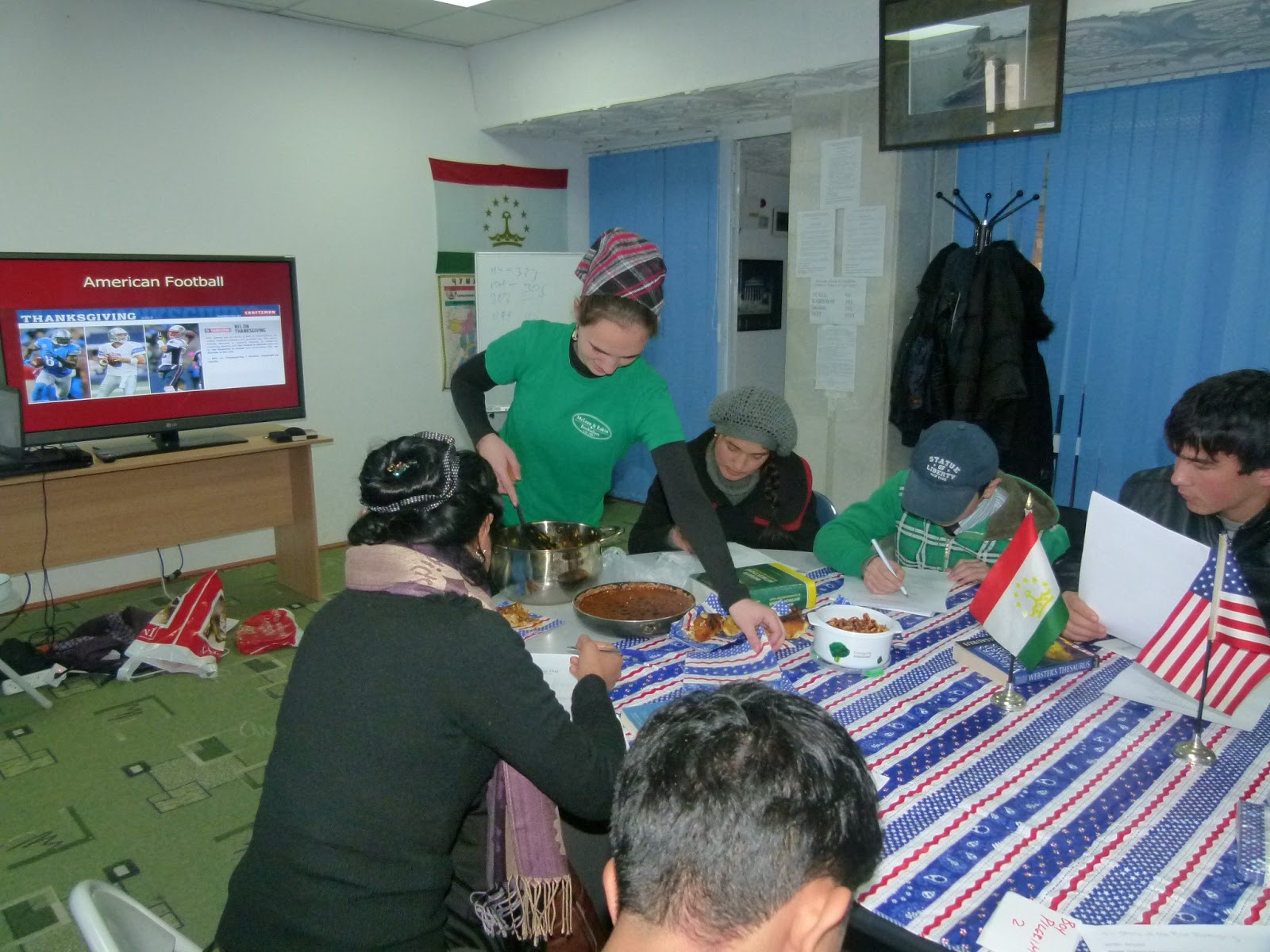
At the American Corner, on the Tuesday before Thanksgiving, I used my regular Discussion Club to make everyone think about what they were thankful for. We also listened to part of a TED talk roughly about being thankful (or appreciative). 

Reading a First Thanksgiving play.
On the day itself, I gave a presentation that went through the basic historical facts, and then I made them read through a simple Thanksgiving play. This is a real American Cultural experience, because it really is what all American schoolchildren do. It was an interesting decision of how much to include, and to look at different websites that advise teachers. I think that public history is fascinating and important, so I started with the basic story: which, again, is what Americans get, and even if you learn more later, it is the narrative that we are celebrating as a country. Every country shapes its own story of itself - Tajikistan very obviously at the moment with Somoni - and the idea of the Pilgrims is an important part of our identity. I also mentioned the Virginia Company, and how it was different; and that things weren't always so happy at Plymouth - you know when the kid in the play says he's hungry, Mom? That's because half of them died that winter. And, right, all of the killing and deaths. But because I wanted to talk about the holiday today in America, I moved on fairly quickly. I talked about food, football, and in my family, the Alexandria Turkey Trot. I served Pumpkin pie.

Cutting the pie while they fill in Thanksgiving crosswords.
Then I ran home, where I was in the middle of cooking a turkey. I was very proud of this turkey, given my lack of experience with meat as a vegetarian for six years. We were very excited to find frozen turkeys; my friend came upon them and seized them both, since they are rare birds. We cut off the necks together in the morning, and she cooked one while I did the other. I was thankful throughout to my boss at the Embassy. She gave us the cookbook that she and her husband wrote in the Peace Corps in Ukraine, which has helpful things like how to cook a Thanksgiving turkey in a finicky oven and without access to fancy ingredients.

This is where the blog will take a turn towards photos of the cooking:

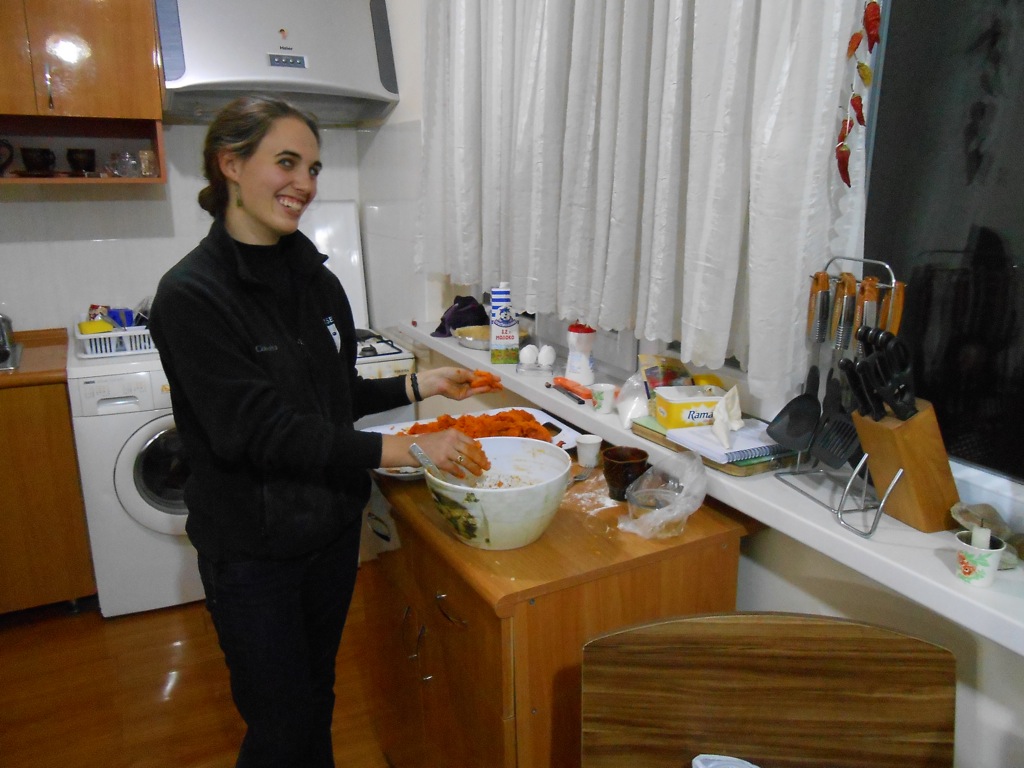
The beginning of the pumpkins.
The night before, making many pumpkin pies.

To make more pie pans I had to take apart frying pans.

Note the tupperware full of roasted pumpkin seeds.

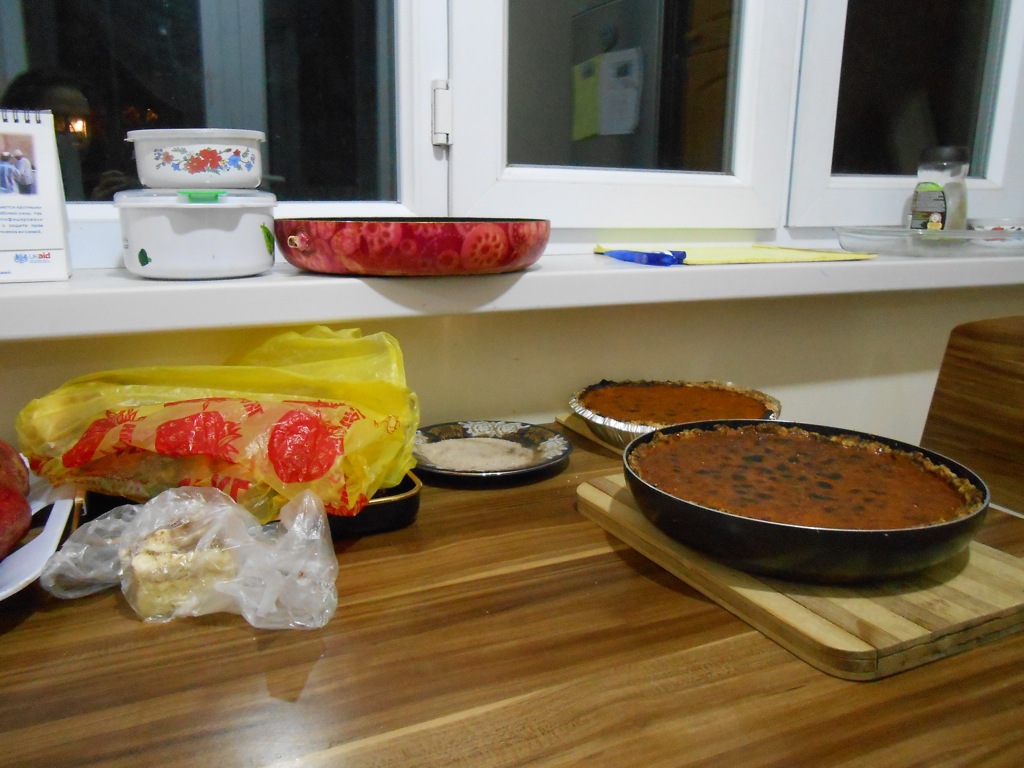
Apple pie beginning in the morning.
The final pie display.

I didn't take photos of the turkey because my hands were too covered in raw meat juice. 

Running back and forth with pies and turkey all day was good exercise for my biceps. At the end of the cooking, we ended up piling into a taxi to take it to the home of the dinner. 

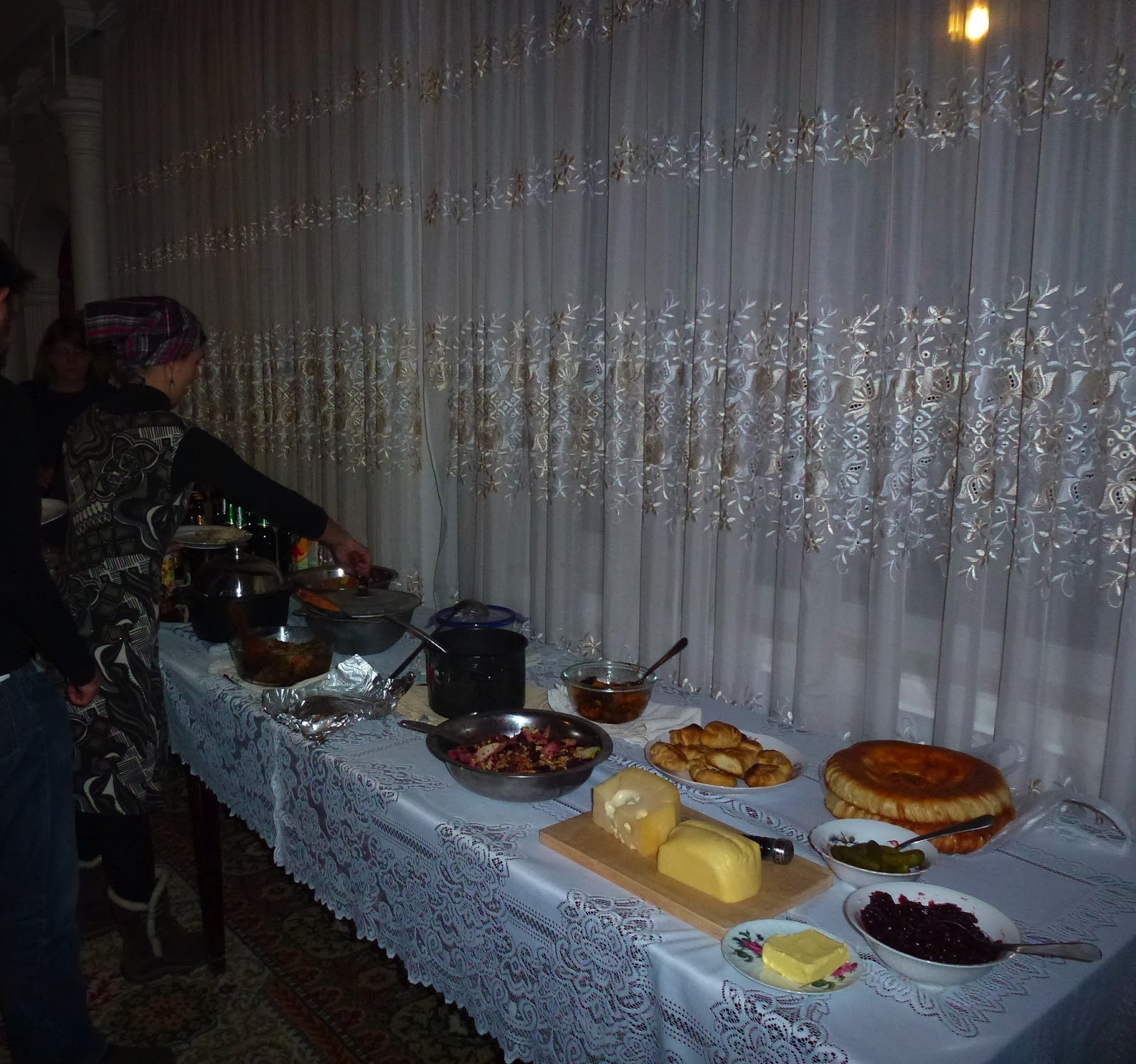
Serving myself from our buffet.

Finishing the gravy in the other kitchen.


Our meal included mashed potatoes, cranberry sauce (imported from America via a Canadian living in Bishkek's boyfriend), salads, mulled wine, and Canadian Beaver Tails along with the pies for dessert. Our feast fed fifteen people: 5 Brits, 4 Americans, 2 Canadians, 2 Tajiks, 1 Austrian and 1 German. Sara was particularly excited that one of the Canadians was a real Mountie. I inflicted the non-Americans with a dramatic re-telling of the Thanksgiving story (though they were lucky, because Sarah and I considered making them do a play). We went home at the end of the night exceedingly thankful, and happy to have celebrated in style.


Thursday, November 8, 2012

Patriotism


"If there is any valuable difference between a monarchist and an American, it lies in the theory that the American can decide for himself what is patriotic and what isn't. I claim that difference. I am the only person in the 60 millions that is privileged to dictate my patriotism." 
- Mark Twain, via my mother forwarding Garrison Keillor's "The Writer's Almanac" on Election Day
I have never felt so patriotic and so American as I did in Khujand, Tajikistan on November 6 and 7, 2012, as I waited and watched for news of the Presidential election. I did not expect to care so much; I did not watch any of the debates, and was grateful to avoid the bitterness of negative campaigning. But as Election Day approached I was entirely in the U.S.A. in mind and spirit.

I got to choose my own patriotism: I posted photos of the State Department election teaching materials on Facebook, and liked every status that had to do with voting. I went to bed, and woke up at 8 a.m. to find that America had started counting. I drank Nescafe and ate a piece of cake with my eyes glued to the Washington Post's webpage - unless I changed to Facebook.  I felt sudden tears when I saw the call. I remembered that NPR is station 20 on our European satellite TV. I listened while making chocolate chip cookies to take into the American Corner for our election celebration. I listened to Romney's speech, and waited for Obama's as I began to plan how, exactly, I would share this with my Tajik students. My internet constantly paused Obama to buffer the video and I gave up and printed the transcript an hour later. I admit to a moment when I felt the urge to sing "Proud to Be An American."

When I finally went to the American Corner, I wore my Tajik-American dual-flag lapel pin on my sweater, an "I Voted!" sticker and an Obama/Biden sticker left by a visiting English Language Specialist. I brought ridiculously American, 4th-of-July-type napkins and tablecloth left by the same teacher. I beamed. My TOEFL class, which is learning strategies for the Listening section of that test, got to listen to Obama's victory speech. They learned the words "concession" and "acceptance."The Election Celebration included a re-cap of the electoral college system, which meant mock elections among the United Three States of the American Corner in Khujand as we chose between Chocolate Chip Cookies and Cake (Cake won, winning the electoral vote 4:1 and the popular vote 10:5). We colored in the map. I brought copies of the cookie recipe. During my Music Club, we listened and looked at the words to Stevie Wonder's "Signed, Sealed, Delivered" (which Obama walked out onstage to before his speech) and Ben Harper's "Better Way"(Obama's theme song earlier in the race). I felt unabashed about my showy Americanism.

It is not that I can hide being American here; I work in the American Corner for goodness' sake. But I chose and owned that role in the run-up to the election, grateful to for the chance to re-learn as I taught. I feel more acutely American while abroad, given the chance with distance to look again at the country.

And I remember how much I am shaped by American history and how much I love beautiful American words: I am so excited to teach the "I Have a Dream" speech. I love if a student asks, "So, there was a war between North and South?" I am beside myself as I plan to teach the Gettysburg Address this month. (Lincoln delivered the speech on November 19, 1863.)

And after that it will be Thanksgiving, but already, at the beginning of the month, I feel so thankful. I felt thankful as I explained our term limits. As I explained, last week, to different classes, how we didn't know who was going to win. I am thankful I could chose to wear stickers, and when and where to wave the flag. I am thankful that I could manage to vote from Tajikistan! (I think; I don't know if my ballot actually made it....) I am thankful, as Twain reminded me, that I could chose to dance around my kitchen with instant coffee and the internet, and then teach with cookies and speeches, all as my expression of love of country.

Sunday, October 7, 2012

Walking Advertisement


I am fairly certain that there is a flashing neon sight above my head that says: "Visa here!" Or maybe it says, "All visa questions answered!" Or perhaps, to some young men, "Marry to go to U.S.!" I'm not positive because I, of course, cannot see this sign; when it was installed, it was made visible only to some Tajiks. At the end of a long day, the desperation this sign invites can become grating, and Americans complain to one another about the feeling that people are constantly accosting us.

Mostly, though, I am sympathetic. I wish that I could do more, but the truth is that I have no power with the consular office. And I don't know that much about U.S. visas having never had to get one. The most I can do is help people understand the U.S. websites that explain visa regulations.

A different question often posed to me is, "Can I join your TOEFL course?" It hasn't started yet, so I say "Yes, come, and we will discuss who will be in the class." At the moment I am terrified because there are so many people signed up, and I need to figure out a fair system of who can be in the class - and turning the rest away. I was telling to the American Corner coordinator that though I want to help the students, I just can't make everyone happy - and I will have to turn some away - if they can't come at that time we can't change the time, it is just be too bad for them - we'll have another class start in the spring - and she said, "You sound like a counselor officer." And that was how I realized that it is the same concern and the same question: "How can you help me get to the United States? This is very important to me, and you are the best hope I have come across."

For them, that is why I am here: to help them with their English so that they have a better chance of winning scholarships and spots in exchange programs and getting to visit or stay in the United States. Or so that they can get better jobs here, as interpreters or as local staff in international organizations like the U.N. or foreign embassies. The stakes are higher than in a standard high school Spanish class in the United States, when no one really cares about learning the language - not the way that people here want to learn English.

And I can help them. Some days that is suffocating and other days it is empowering. Mostly I remain somewhere in between, with a sense of responsibility to do my best by my students. Usually I feel this responsibility more heavily than my sense of responsibility to the U.S. Embassy or the U.S. State Department or the U.S. taxpayers who are paying for my grant stipend. I am lucky that the two loyalties do not conflict in my job description, but I can see more and more clearly how my presence is viewed differently by different people. That flashing neon sign above my head is dimmer to some, and has different words for different people. I can try with writing and speaking, but I don't think I can fully control what the sign says to you.