Showing posts with label holidays. Show all posts

Wednesday, March 27, 2013

Баҳор омад. Spring comes.

This past week was Tajikistan's most important national holiday, Navruz. It literally means "new day" but is the Persian New Year and marks the spring equinox. When I wrote this to my Grandmother, she replied,
The people over there certainly have the right idea – new year beginning in the spring.  How sensible.  
I have to agree.

It means almost a week off school for concerts and parties. Everyone wears national dress. There is much dancing. There is much poetry, much of which involves the phrase баҳор омад (bahor omad, spring comes).

Here, people are eager to say that it is an International holiday, which someone declared a few years ago, since today people celebrate Navruz in Iran, Afghanistan, Tajikistan, Kazakhstan, Kyrgyzstan, Turkmenistan, Turkey, parts of China and probably elsewhere I am forgetting. Sarah and I were interviewed to discover our thoughts on Navruz as foreigners, but we didn't see the TV special when it aired. Several of our students and neighbors did, though, and some have approached me since to excitedly, "You speak Tajik!"


At the library, the celebration on the 20th included: a competition of who has the most beautiful table of food (scores could be augmented by poetry recitation), poetry recitation, dancing, a holiday tableau, the arrival of girl in white as "spring", who showed off the haft seen and haft sheen, a poetry contest, a humorous skit, displays of national dress, and speeches. I was encouraged to stand up and congratulate everyone on Navruz in Farsi and English, and later a representative from the Iranian embassy's ministry of culture presented me with a gift. It ended with everyone dancing as the women cleaned and put everything away.


Navruz (21st) in Khujand seemed to be an excuse for kids to run off and play with their friends. Two of the volunteers from the American Corner showed me around the crowded park, where people were selling shashlik every three yards. We went on the Ferris wheel, on a boat ride, and talked as we walked past everyone in their finest clothes.


Sarah and I missed the official Khujand celebration on the 22nd, because we were guest-ing in different parts of Sughd for the rest of the weekend. On the 21st we went to Mangit village in Ghonchi, where one of Sarah's students lives. He took us immediately taken to the village party and we danced. I chose the 11-year-old girls as my partners instead of the teenage boys. 

 
We stayed two nights, and went to many other family members' houses to be guests, which means introducing ourselves and drinking tea and eating food. Both nights included dance parties with all of the neighbor kids outside of the house. Sarah and I apologize for being poor representatives of our country when they put on a J-Lo song and told us to "dance American".


We also visited some women making сумалак (sumalak), the traditional Navruz dish. I was only told the story of sumalak the next day, but it is beautiful and goes something like this: Once, long ago, a widow had nothing to feed her children. The children cried to their mother that they were hungry, but she had nothing to give them. One night, the mother threw seven stones into a pot with wheat and some flour and fell asleep with despair. While she slept, thirty angels (see malak) came and stirred the pot. When she woke up in the morning, the woman tried the dish and found that it was delicious.


Now people make sumalak in the spring, when the shoots of wheat are young. It must be cooked from 12-24 hours, and women stay up all night, adding wood to the fire and water to the cauldron as they stir and sing to keep themselves awake. If you make a wish while stirring sumalak, it will come true. Sarah and I did not stay so long, but we visited for a little while.


Later that night, I got my hair braided in the traditional style: many little braids finished by cotton tassels at the end of each braid. It took less than two hours, and it is usual for everyone to ask how many braids you have. I ended up with 24 - traditionally one should have 40 braids.


The next day I went to Shahristan. The first night, instead of staying with an English teacher we know, I ended up being the excuse for five 16-year-old girls to have a sleepover. They giggled and talked all night and in the morning we all beautified ourselves with усма (usma). Now, to most Westerners, this is not beautiful. I have plucked my eyebrows at least since I was thirteen. But with usma, you draw your eyebrows thicker, darker, longer, and they are supposed to meet in the middle. It is a green plant that they make into a juice. You paint it on three times, letting it dry some between each application, and then you wash it off - gently! the girls told me, alarmed as I splashed my face.

There is also a story behind usma, which again I learned only after the fact: people believe that on judgment day, all of your body parts will be forced to tell their sins from your life. Your hands, for example, will say that you stole, and your eyes will say that you looked on something covetously. But if you put usma on your eyebrows, they will be so grateful for your care of them that they will lie for you, saying that they are above all and can see everything and that you did good deeds. In conservative villages where fathers will not allow their daughters cosmetics, usma is still encouraged (and some girls sneakily put it on their eyelids as well to simulate the makeup they're not allowed to wear).


My makeover was made complete with либоси мелли (lebosi melli), which literally translates as "national dress." When I mentioned that Sarah had an adras dress (made of this particular fabric and pattern) and I did not, they secretly went to the bazaar, bought some fabric, and brought one student's sister over to measure me "for no reason." In the morning, she arrived with the dress she had worked on all night and took no money for. It might be the most thoughtful gift I have ever received.


This was all for the Navruz celebration that the students had prepared in Shahristan, which involved everyone in national dress, poetry, songs, a skit, and more dancing. Sarah and I were forced to have a dance competition. We walked, played a game, and the reward when I won was that I had to dance for all of them.
 
Photo credit to Sarah and her iPhone.
When we stayed with the teacher that night many more people came to see us, but more exciting was that I finally learned how to make osh-e plov, the national dish of Tajikistan. In the morning we helped bake the bread in the tandur (outdoor oven).


Then we came home and still had a day and a half to sleep before the library opened again.  I tried to answer some emails. I showed my colleague how to make chocolate chip cookies. I welcomed spring.

Friday, December 21, 2012

Winter Wonderland


It is so nice to be home in Khujand. I realized when I arrived that I had missed it. It is so nice to know where things are, and to know what people are saying. It has become true winter. It snowed this week. The library put out carpets along the granite walkway so people don't slip. The supermarket also put carpet on its steps - and I had to step around a stray dog who realized that that was the warmest place he could be. Khujand's winter wind has arrived with it: last Sunday it was "12F, feels like -6F." I am in more layers than I wore in Almaty.

Sorry for not specifying earlier, but the travel home from Kazakhstan was eventually successful. It was not certain: after missing the flight Tuesday, I went to the very helpful men in the USAID travel section, who told me that the Ministry of Foreign Affairs was closed on Wednesday and 'they often take five days to process visas, so you need to be prepared to not make your flight on Friday'. But I did. Of all the potential answers to "everything happens for a reason," the most compelling is that I was meant to arrive in Dushanbe with all of my fellow ETAs. And then I hopped straight onto the plane to Khujand, and spent a very pleasant flight talking to a new friend who even drove me home to our apartment.

Once home, though I was happy about snow, our apartment building was not happy about the cold: we were without water for three days, and the eventual solution involved breaking into the empty apartment next door with a crowbar and holding a hairdryer against the dusty pipes until the water unfroze. Now we are supposed to keep a constant drip of running water to prevent re-freezing (I'm sorry, Burgundy!).

But we could stay warm with my souvenirs and gifts from Kathmandu: scarves for Sarah and Madina, and wool throw blankets for the apartment, which became a stylish shawl when worn to the American Corner. I gave a presentation about Nepal, showing them thankas and rupees and prayer flags. They were excited to hear, and I was excited to be back at the American Corner and to share.

My TOEFL students are my favorite (don't tell), because I actually see them regularly and have gotten to know them. Our last class was on Wednesday, and I had prepared surveys for them to fill out, printed out certificates (with out new color printer!), and made brownies. I was utterly surprised when they had a present for me. It was so sweet, and they were all so earnest in their thanks. They wanted me to know that they appreciated the class, but also that they were thinking of me since I was far from my family for the holidays. The present was one of the decorated cardboard New Year's boxes that they sell in the grocery, with chocolate inside (I think I talk too much about how I like chocolate). Only when I got home did I see their note, written on a 3D Christmas tree card.

Well, not Christmas tree - New Year's tree (in Tajik, archa). I had no idea how much Russian New Year's celebrations and decorations have become part of the Tajik December. In the middle of Lenin street there is a huge tree, which is lit up at night, and a stage behind where there are now concerts every day at 2 p.m. We foreigners see Santa faces on the tree, and tinsel and other Christmas decorations in the bazaar. They see a New Year tree and "Boboi Barfi" (Father Snow).

The courtyard between the mosque and Panjshanbe bazaar currently features a large New Year's tree and several Father Frosts willing to take a photo with you. 

Either way, 'tis the season. The week has been full of talking and dinners: at the Grand Hotel with Embassy visitors, in our kitchen with a neighbor bringing coffee and at a friend's apartment with pasta, tea and decorations. I downloaded albums from my two favorite singers of Christmas songs: Michael Bublé and Nat King Cole. They've been on repeat as I drink Seattle's Best Coffee from our new drip coffee maker.

Saturday, November 24, 2012

Khujand Thanksgiving


I considered writing a play along the lines of the First Thanksgiving plays we make Elementary School children do; then I thought about writing a recipe for our Thanksgiving. Instead this blog post is going to end up one part teaching reflection, one part food blog, and one part social report. 


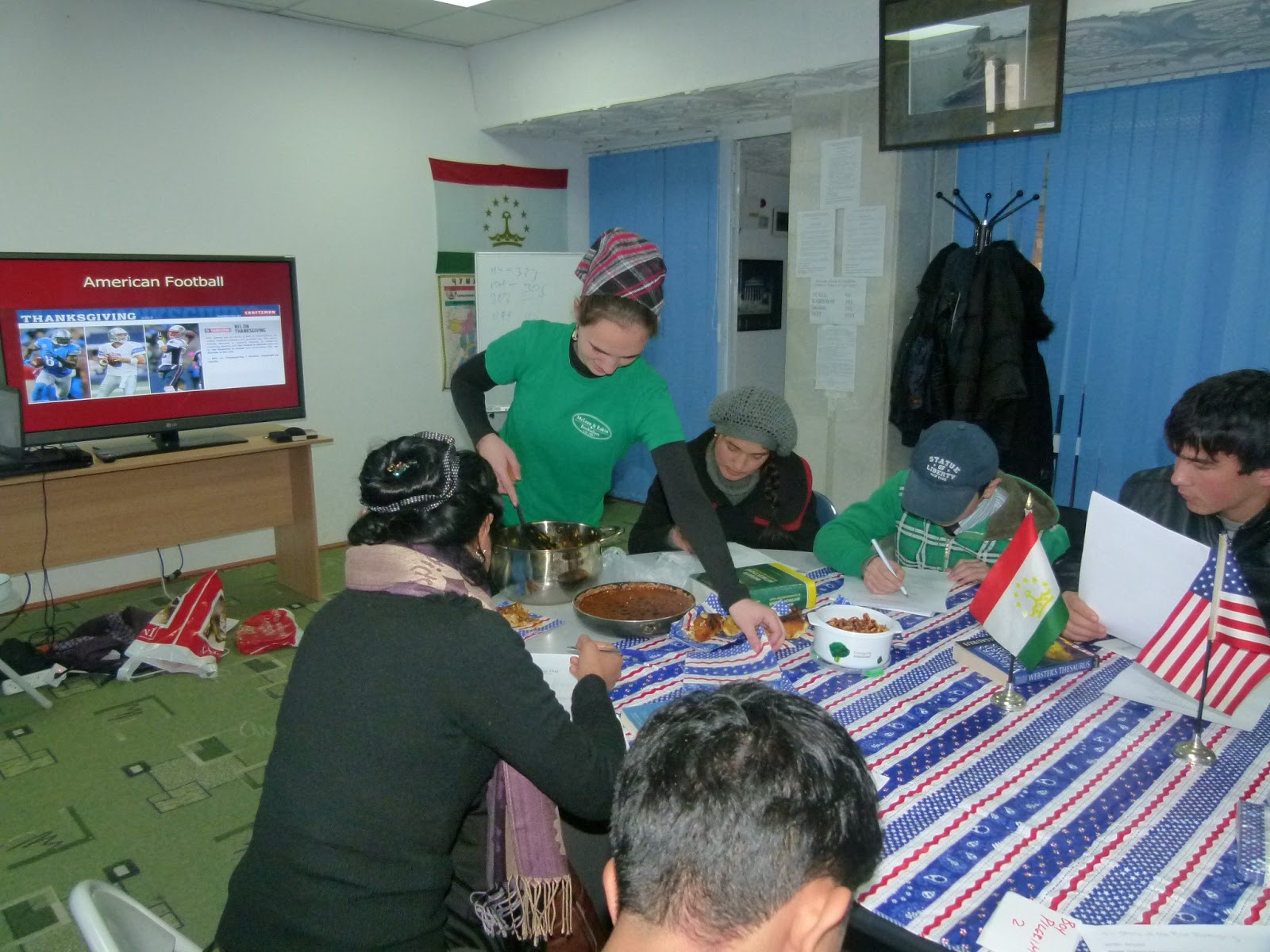
At the American Corner, on the Tuesday before Thanksgiving, I used my regular Discussion Club to make everyone think about what they were thankful for. We also listened to part of a TED talk roughly about being thankful (or appreciative). 

Reading a First Thanksgiving play.
On the day itself, I gave a presentation that went through the basic historical facts, and then I made them read through a simple Thanksgiving play. This is a real American Cultural experience, because it really is what all American schoolchildren do. It was an interesting decision of how much to include, and to look at different websites that advise teachers. I think that public history is fascinating and important, so I started with the basic story: which, again, is what Americans get, and even if you learn more later, it is the narrative that we are celebrating as a country. Every country shapes its own story of itself - Tajikistan very obviously at the moment with Somoni - and the idea of the Pilgrims is an important part of our identity. I also mentioned the Virginia Company, and how it was different; and that things weren't always so happy at Plymouth - you know when the kid in the play says he's hungry, Mom? That's because half of them died that winter. And, right, all of the killing and deaths. But because I wanted to talk about the holiday today in America, I moved on fairly quickly. I talked about food, football, and in my family, the Alexandria Turkey Trot. I served Pumpkin pie.

Cutting the pie while they fill in Thanksgiving crosswords.
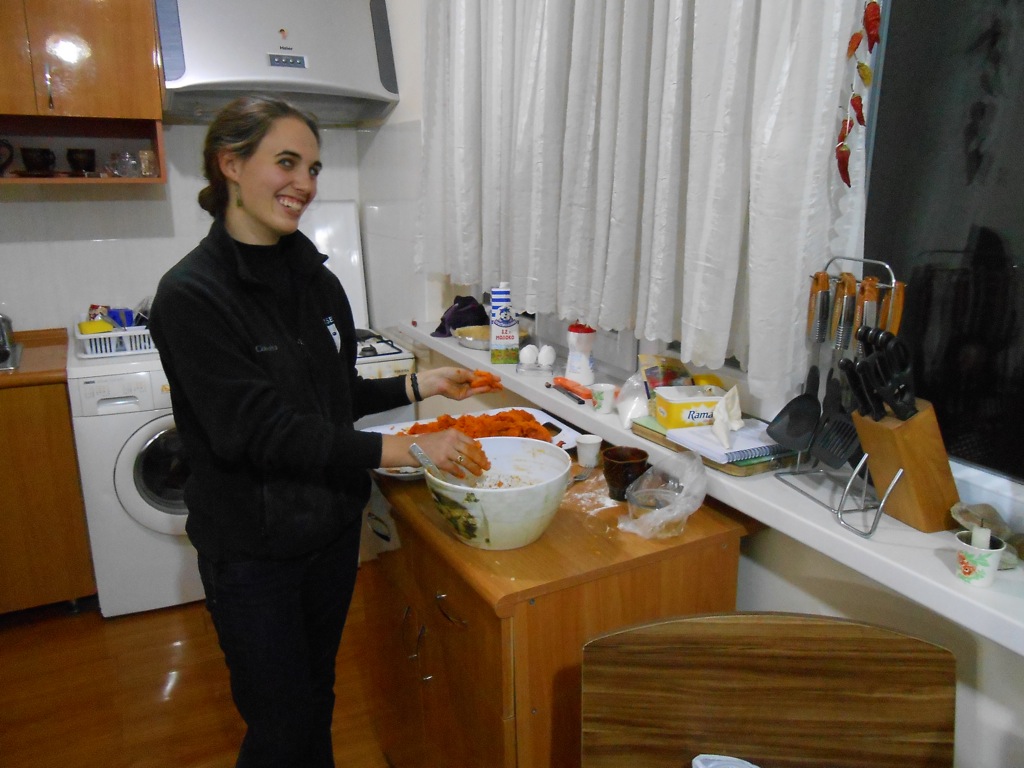
Then I ran home, where I was in the middle of cooking a turkey. I was very proud of this turkey, given my lack of experience with meat as a vegetarian for six years. We were very excited to find frozen turkeys; my friend came upon them and seized them both, since they are rare birds. We cut off the necks together in the morning, and she cooked one while I did the other. I was thankful throughout to my boss at the Embassy. She gave us the cookbook that she and her husband wrote in the Peace Corps in Ukraine, which has helpful things like how to cook a Thanksgiving turkey in a finicky oven and without access to fancy ingredients.

This is where the blog will take a turn towards photos of the cooking:

The beginning of the pumpkins.
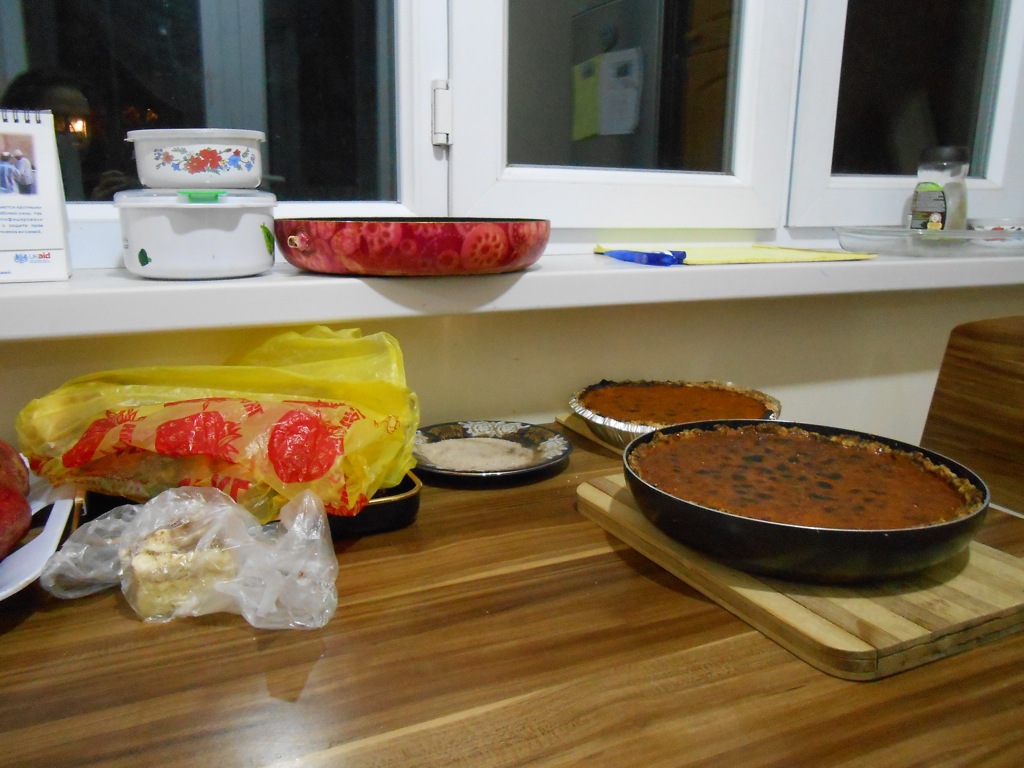
The night before, making many pumpkin pies.

To make more pie pans I had to take apart frying pans.

Note the tupperware full of roasted pumpkin seeds.

Apple pie beginning in the morning.
The final pie display.

I didn't take photos of the turkey because my hands were too covered in raw meat juice. 

Running back and forth with pies and turkey all day was good exercise for my biceps. At the end of the cooking, we ended up piling into a taxi to take it to the home of the dinner. 

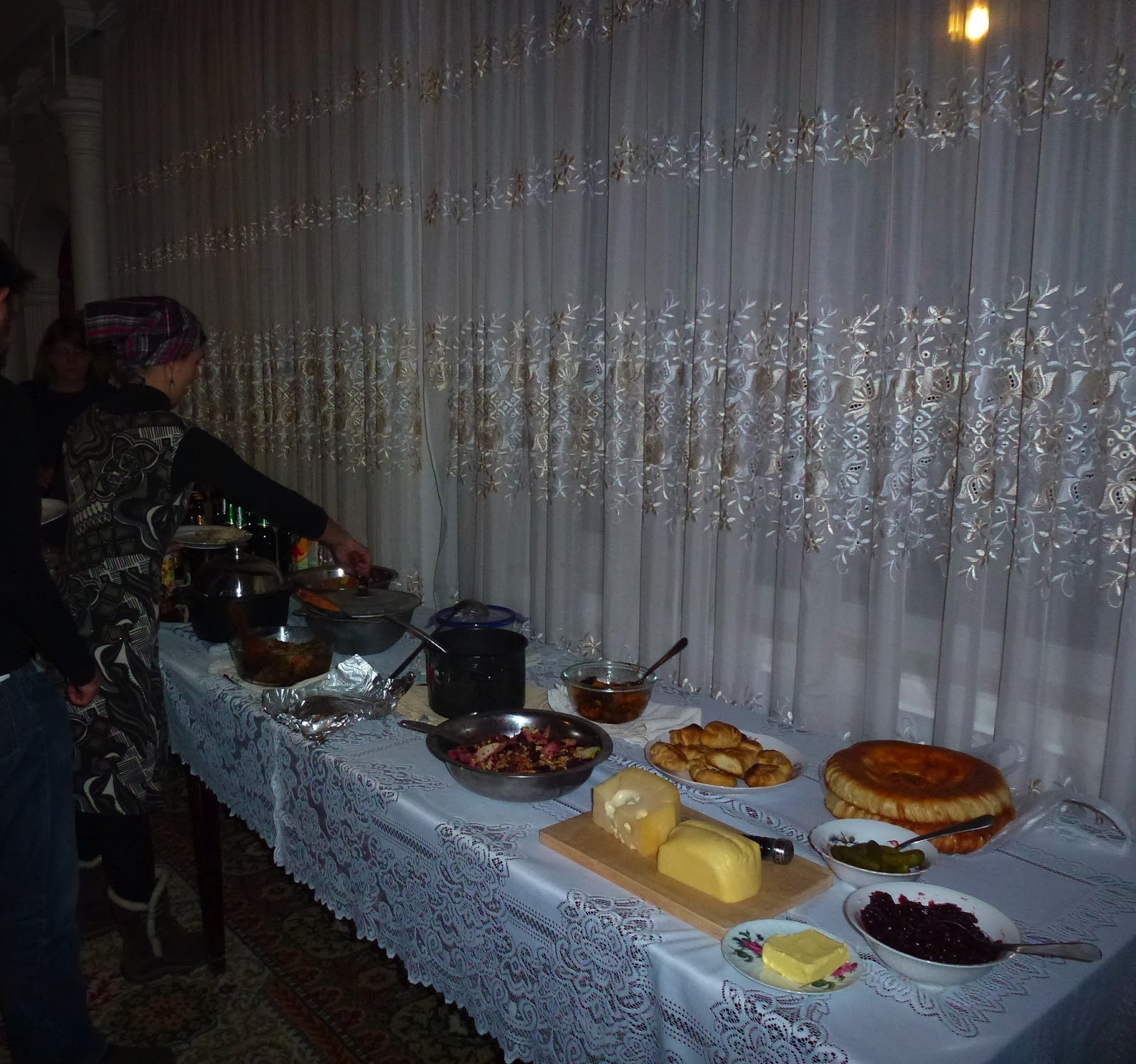
Serving myself from our buffet.

Finishing the gravy in the other kitchen.


Our meal included mashed potatoes, cranberry sauce (imported from America via a Canadian living in Bishkek's boyfriend), salads, mulled wine, and Canadian Beaver Tails along with the pies for dessert. Our feast fed fifteen people: 5 Brits, 4 Americans, 2 Canadians, 2 Tajiks, 1 Austrian and 1 German. Sara was particularly excited that one of the Canadians was a real Mountie. I inflicted the non-Americans with a dramatic re-telling of the Thanksgiving story (though they were lucky, because Sarah and I considered making them do a play). We went home at the end of the night exceedingly thankful, and happy to have celebrated in style.


Thursday, November 22, 2012

Giving Thanks


This year, as every year, I am thankful for many things: my family, my friends, my health. I am thankful that I have internet access to be able to keep in touch with my family and friends. I am thankful for the new friends - the family - I have made here. I am thankful for the Fulbright Program, and the many people at the U.S. Embassy in Dushanbe who are so supportive.  I am thankful that I can mostly do what I want. I am thankful for the opportunity to be in Tajikistan.

Being here also reminds me to be thankful for many things that I take for granted in the United States:  an education system that teaches to standards and requires hard work; a democracy that holds contested elections, as ours reminded me; and cultural structures that value women as equals to men. Today I want to dwell on how thankful I am for my rights as a woman.

I am thankful that my parents always encouraged me. In everything. I am thankful that they expected me to go to school and to go to college. I am thankful that my teachers and community encouraged me to play sports and participate in every activity as well as my male peers. I am thankful that I still have my parents' support as I figure out what is next.

"When do you plan to get married?" a Tajik male asked me. I have no plan, I told him. It depends on when I meet someone who I think I want to marry. "When do your parents want you to get married?" he persisted. My parents have almost no say in the matter, I told him, to his surprise. I am so thankful that my husband will be my choice: both who and when. 

When and if I marry, I am thankful that my husband and I will not have to live with his family if we do not want to. I am thankful that we will share cooking and cleaning duties. I am thankful that I will not ask my husband permission to travel, and that he will be supportive of me working. I am thankful that I have the education to understand my legal rights should he not treat me well. I am thankful that my family would not be disappointed if I gave birth to a daughter.

Not everything is perfect for women in America; we have plenty of recent news and politics to show us that. More subtly, our assumptions are not always so different from those here. Americans also obsess over dating and marriage. The time scale is different - "If he hasn't been married by 45, something must be wrong with him," an American acquaintance remarked the other day - but people still think you should marry. And there are spheres that are almost exclusively male. "Even in America it is not common for women to be boxers?" a Tajik friend asked, surprised, when borrowing Million Dollar Baby. No, I said, not at all; it is a men's world. [A Tajik woman won a bronze medal in boxing in the Olympics this summer. This fall she got married and announced that she is taking a year off from the sport.]

But though not all is equal in America, there are people trying to change that. In Congress or on the editorial pages of newspapers, there are many people defending a woman's right to participate in sports, or to stay single, or to do anything else. I am thankful that I was born in a time and a place where I was told that women can and should expect rights equal to men's, and that if it is not the case, then I should fight for those rights.

Of course there are people fighting for those rights here, and many women have seized them for themselves. I have met women who are lucky to have support from their parents in their job, or in choosing their husbands (which is more common now). I have met women who are do not feel constrained by some of the things I would find constraining. I am thankful for the chance to learn from many different opinions on these issues, from students and friends, male and female.

I am thankful for all of the opportunities I have been given without regard to my gender, and thankful that I have the time here to realize that. 


Coming soon: The Story of Tajik Thanksgiving. Featuring: Turkey! Pies! More Thanks!

Monday, October 29, 2012

Abraham's Stars; or Many Holiday Thoughts

Friday was Eid-i Qurbon (Иди Қурбон), known elsewhere in the Muslim world as Eid al-Adha (adha and qurbon are both Arabic words for sacrifice, the later used in the Persian world). Somehow amongst all of the times I have heard and read about Ramadan and Eid al-Fitr, the second great festival of Islam escaped my notice. Tajikistan has helped me rectify that omission, by hearing about Eid-i Qurbon from Tajik friends, and reading about it, and experiencing it. Like the holiday, this blog post encompasses too much: celebration, language, giving, religion, contradictions, traditions, vacation and family.

I asked the American Corner Coordinator, Madina, to explain it to me. She explained that it is the "Feast of Sacrifice," celebrating Abraham's near sacrifice of his son, and thus passing his test of faith. It is the end of the Muslim year, and the time when people go on Hajj to Mecca. The festival always two months after Ramadan, and so cycles about eleven days earlier each year. Some people fast for ten days before Eid-i Qurbon. During the holiday, people spend time with their families, and visit older relatives. Those who are able should sacrifice a sheep, and share the meat with family, friends, and those less fortunate.

When a thirteen-year-old on student said "Congratulations on our holiday!" Thursday morning, I explained that though "Eid-e mubarak" does translate "congratulations," that's not usually what we say in English. We like to say "Happy [insert holiday]," or "Have a good holiday." Imagine my delight when I learned later in the day that many people say "Иди нагз гозарид (Eid-i nagz gozareed)," which translates almost exactly to "Have a good holiday."

On Thursday afternoon, I spent time with some American Corner volunteers taking food to families in need. One of the volunteers had been inspired to put out a donation box earlier in the week, and on Thursday the money was collected and taken to the grocery. They came back with flour, rice, buckwheat (grechka), sugar, oil, black tea, soap and shampoo. We grabbed at the items hastily to put together fourteen bags in the road behind the taxi so we wouldn't have to lug the food to the Corner on the fourth floor. Five of us piled into the taxi to look for the homes on the list that the mosque had provided. The others joined us later via mashrutkeh and walking. As we walked to a house, we played the "What is this in English/Tajik?" game ("Sunflower" is офтобпараст - oftobparast - lit. sun-worshipper, which is delightfully similar. We spent ages as they tried to explain to me a small bird is in the hopes I would know the English name.). The experience was entirely similar to Thanksgiving and Christmas volunteering run by schools and churches at home.

I first heard Abraham's story at church when I was young: God tested Abraham's faith, asking him to sacrifice his son. Abraham was ready to cut Isaac's neck when an angel appeared to stop him and he sacrificed a ram instead. Since he has passed the test, God made a covenant with Abraham: he would have as many descendents as stars in the sky.

When I heard the story in church it was mostly upsetting ("Mom, would you kill me if God asked you to?" The answer better be 'no'). Of course that is exactly why it is a powerful illustration of faith.

But I got a very different reading junior year in a seminar entitled "Bible as Literature" with an inscrutable old professor named Leslie Brisman. It was a secular class based in the English department, and involved comparing different translations and discussing the text in relation to the documentary hypothesis of the Pentateuch (four different authors). Brisman delighted in surprising us with literary analysis, and I particularly remember his explication of Genesis 22. If there are different authors, one intends the story's moral much as I first understood it: God sends his angel to stay Abraham's hand. Another reading - if verses 11 and 12 are excluded - is that an angel did not appear, but the ram did, and Abraham took advantage of its presence to sacrificed it instead of his son. The moral of this story is not blind obedience but ingenuity and problem-solving in the face of a difficult task; can he obey to the extent that is reasonable, and figure out when not to obey.

I was interested to read (a translation of) the passage in the Koran. I had heard that it is Ishmael who is nearly killed, not Isaac, but figured the message is the same. There is an interesting twist, though: Abraham actually asks his son whether he is willing to die. Ishmael agrees, which is seen as a sign of his own faith and maturity. The faith of both father and son is important. This is in contrast to Genesis' Isaac, who seems to be ignorant of what is going on, though smart enough to catch on to the fact that something is not quite right since he notices that there is no sheep as they are headed to the sacrifice. Abraham basically lies and tells him not to worry about it. Both versions of Abraham show him as a father to one boy - in one personal and emotional moment. This is more relatable than Abraham, Father of Three Religions. The scripture gives a story which is then layered and refracted through the rituals of Hajj and Abraham's vast legacy; this is a time to celebrate.


I experienced the celebration on Friday mostly as a holiday in the British sense; no work or school. The streets were quiet without the gangs of black-and-white-uniformed children. Somon bazaar was closed. It rained for the first time in the months I have been here, which led to Sarah and I sleeping in and then making a luxurious breakfast of crepes (banana and nutella) and American coffee. The afternoon was clear and chilly, but not cold. So we went out on a walk, and realized that fall has come as we walked over fallen leaves and past yellow trees. We walked over the river and through the mosaics to Ismoil Somoni's statue.

I was obligated to take photos for my parents and my local coffee shop. My parents sent me the coffee via a coworker's husband's visit to Dushanbe and then an Embassy delivery north. The coffee is from Misha's, the Alexandria coffee shop  that my dad and I visited every Saturday morning from when I was three years old through high school.  On their fridges, Misha's posts photos of people holding their coffee cups in far away places. I would like to think I have made some sort of record.

I held a cup from home and it felt like a fall holiday, so Sarah and I started talking about our Thanksgiving traditions at home. For our Thanksgiving holiday here, we plan pumpkin pie and a bird and some cranberry sauce via Bishkek if we are lucky. Perhaps even some American Football - we have a ball at the American Corner. I can practice being thankful for what I have learned and had time to think about, and plan for how to explain our own holiday in its own glory of story and history and contradictions and tradition all wrapped in language.