Showing posts with label food. Show all posts

Sunday, May 19, 2013

Summertime and the livin is easy

The summer solstice may not be until June, but as far as I'm concerned, summer has come. The first fruit has come, syrupy sweet: strawberries first, which became bars and two strawberry rhubarb pies in one week, followed by cherries and almost, now, apricots.

The trees along the street produce a sickeningly sweet pollen. Among those trees are too many swallows to count. Along the roadsides I spy gorgeous Rollers in all their blue and rufous glory. There are dragonflies and butterflies winging along the river.
Poppies began spreading along the roads and into the fields in April.
Outside the library.
On May 1st, roses have erupted everywhere, and they have been multiplying in a fury ever since. "Rose" in Tajik is " садбарг (sad barg)," which literally means "100 petals." A row of men sell flowers under a САДБАРГ sign every day of the year, while a restaurant behind them takes the same name, and is one of the nicest places to sit outside with an ice cream under their willow trees. 
From our kitchen window.

Ice cream is part of my daily diet. 

In America we mark the beginning of summer with Memorial Day. Here, we began May with two holidays from the Soviet era: 1 May (Labor Day) and 9 May (Victory Day). Regardless of the holidays' purpose, our celebrations were pure summer.

May 9 involved a long hike in a village. Students kept asking me why I was looking at the sky (wishing I had binoculars to look at the hawks).  I stopped and took photos of flowers, and this grasshopper, but didn't get a photo of my first Tajik toad.

I spent both days the following weekend having picnics. Sarah and I taught schoolchildren to pay modified American Football in the Botanical Garden on Saturday, and then on Sunday a group of students from the American Corner kept trying to teach me how to throw a football correctly during our daylong excursion by the river away from the city (I tried to tell them that I have been a failure at this my whole life in America, but that did not deter them from trying). 

Explaining the rules of our game
Botanical Garden Picnic.


I wear sandals every day. Sometimes I wear sunglasses. When on a picnic or kayaking, I wear a hat.

It may not be high summer - there is not yet mellon, and I can't say that "the cotton is high" - but all of these things unequivocally mean summer to me. 
Walking to the river near Палос (Palos). 

Playing Hearts by the river as the wind picked up.


Thursday, January 24, 2013

Five Months


On Sunday I submitted my Mid-Year Report, which is required of all Fulbright grantees half-way through their grant period. Which means that it has been five months since I landed in Dushanbe, and now there are less than five months left. All of a sudden, ten months seems not long at all, and I realize that I will soon be one of the Sharons and Davids that people here remember coming and leaving. 

Marking January 1st - while fun - was not as meaningful to me. I still measure my life in school years. If I am to measure by calendar year, then I should be reflecting on all of 2012: writing my senior essay and hanging out in our common room and graduating and the Cove and Tajikistan. It is a colorful and exciting collage, but not a cohesive whole. Rather than making New Year's Resolutions, I have made Fulbright Resolutions, or perhaps Fulbright Realizations: what I have realized since August 20, and what I plan to realize by June 13, when I fly back to the U.S.  

My Fulbright Renewals are the result not only of realizing I am half-way, but also the result of returning after a month of traveling. First to Nepal, then return-trip detour to Almaty, then back in Khujand for a week of winter, then to Italy, where I met my family and celebrated Christmas. I arrived again in Dushanbe on New Year's Eve and came back to Khujand three days later when my baggage arrived. 

I was met at the American Corner by a flurry of students finishing their applications for the Global UGrad progam. I was swept into essay-reading and turning away reference requests. In the three weeks since, I have made myself much busier than I was September-November. I now have morning classes, instead of lazy planning sessions. One is my new series of TOEFL preparation trainings (the American Corner as a Public Organization is not legally qualified to teach 'classes,' only provide 'trainings'). That involved a sign-up, a test to scare people away, and fighting away late-comers. I also have a "Reading Club" (read-aloud time) and a Hunger Games book club. I am teaching an advanced writing workshop (we are working on essays, starting with a biography - think middle school). I am trying to start a competitive debate club, rather than my open-to-all debate/ activity/ discussions. I have had extra classes with visiting groups of 30 kids each from two different nearby towns. I have put a lot of time into thinking about how to teach about Martin Luther King, Jr. and the inauguration.

I have benefited from taking to heart another ETA's self-identification as an after-school programmer rather than a teacher. Extracurricular is a better word: you cannot be 'after school' if there is no school. The government declared there would be no school in January this year because it was supposed to be too cold to heat classrooms - something that does not happen every year, but did happen last year. University students are either in exams or on break. The American Corner is crowded. 

This means I come home more tired and stay up late planning - but now I have real coffee to help me get up in the mornings. And when I am teaching, I am moving and thus warmer than sitting in one place. 

January has been milder than (the one week I saw of) December, but it is still cold. My winter wardrobe includes a scarf every day - worn tied behind my head with the ends hanging - plus leggings, pants, turtleneck, sweater, coat, gloves. All of those are worn inside as well as outside. It used to include black boots, but the heel broke and I haven't had time to take it to the cobblers at the bazaar (they fixed both zippers on the same boots for 5 somoni). 

Our water is not the most reliable: pipes have frozen twice, and the pump stopped working once, but now it just ebbs and flows throughout the day so sometimes we have to turn on the pump to get any warm water or even to get enough to wash the dishes. 

I eat a lot of soup. I made some delicious braised cabbage this week. I try to remember to get vitamins somehow, even though vegetable selection is sparse and I forget about the fruit when it is not shoved at me (apples are now 7 somoni a kilo instead of 1 somoni/free in buckets in the fall). I drink a lot of honey-and-lemon. Lemons here are large and sweet and more lemon-y. 

More plans to realize: See a game of buzkashi. Celebrate Navruz exuberantly. Go hiking. Use my binoculars and my new Guide to the Birds of Central Asia. Try to learn more Tajik music. Actually study Tajik vocab. Spend more time with people. 

The hardest questions for me to answer in my mid-year report were in the "Cultural and Social Adjustment" section. 
  1. What were your strategies for getting acquainted with the people and the culture? 
  2. What kind of changes did you make in order to adjust to the local culture?  

"Were," "did;" do they mean that my adjusting is all in the past? I am comfortable here, and I think I often know what to expect, so in that sense, yes. But while I might be "adjusted," I am merely "acquainted" with people and culture, and I agree - I do not feel that I know much of anything. I ended up answering in the past tense what I was really meant as directions to my future self for the rest of my time: Be available and present with people.  Listen more than I talk. Work on figuring out when and how to hang out with people. Continue trying to figure out everything.

Saturday, November 24, 2012

Khujand Thanksgiving


I considered writing a play along the lines of the First Thanksgiving plays we make Elementary School children do; then I thought about writing a recipe for our Thanksgiving. Instead this blog post is going to end up one part teaching reflection, one part food blog, and one part social report. 


At the American Corner, on the Tuesday before Thanksgiving, I used my regular Discussion Club to make everyone think about what they were thankful for. We also listened to part of a TED talk roughly about being thankful (or appreciative). 

Reading a First Thanksgiving play.
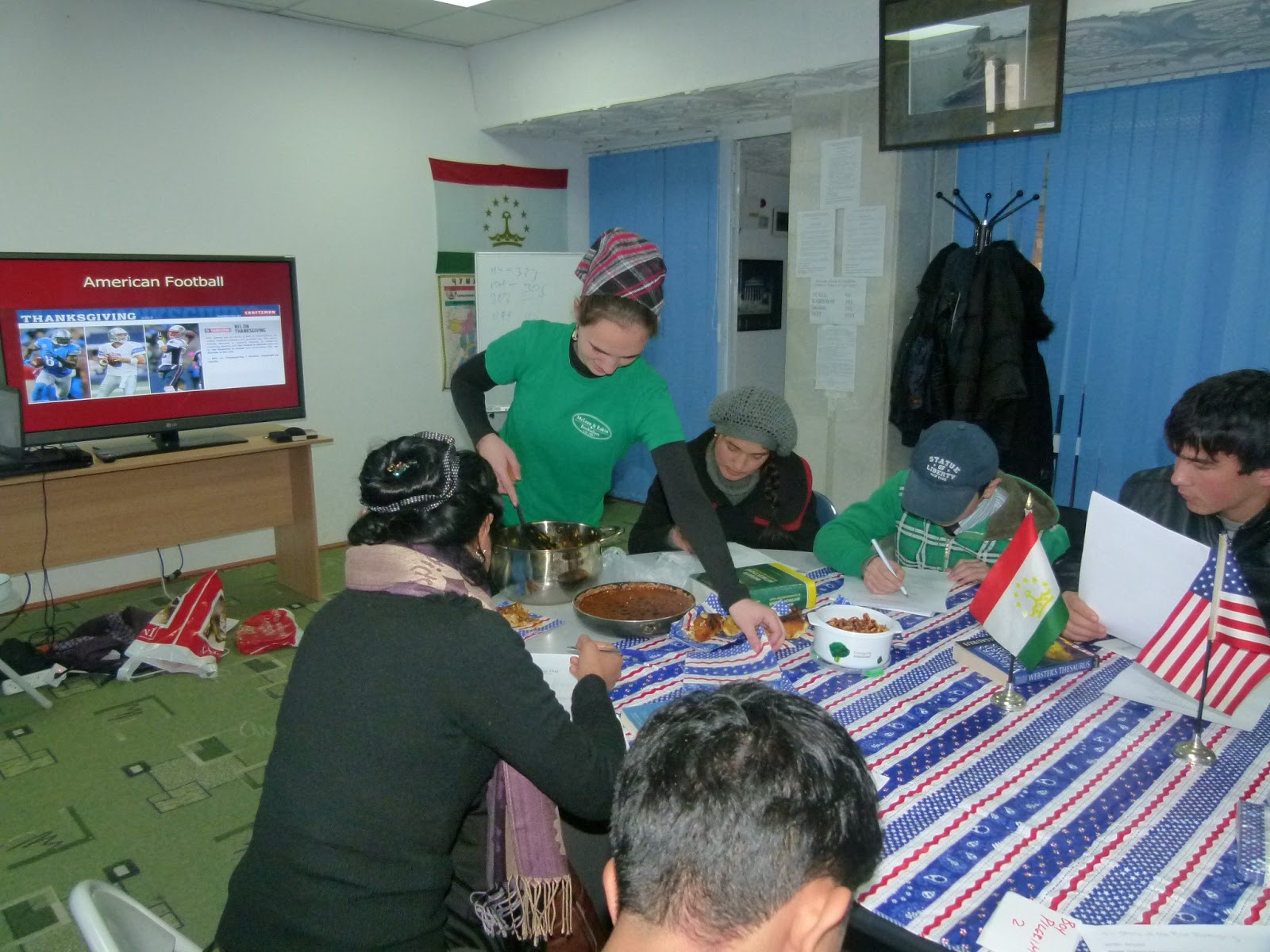
On the day itself, I gave a presentation that went through the basic historical facts, and then I made them read through a simple Thanksgiving play. This is a real American Cultural experience, because it really is what all American schoolchildren do. It was an interesting decision of how much to include, and to look at different websites that advise teachers. I think that public history is fascinating and important, so I started with the basic story: which, again, is what Americans get, and even if you learn more later, it is the narrative that we are celebrating as a country. Every country shapes its own story of itself - Tajikistan very obviously at the moment with Somoni - and the idea of the Pilgrims is an important part of our identity. I also mentioned the Virginia Company, and how it was different; and that things weren't always so happy at Plymouth - you know when the kid in the play says he's hungry, Mom? That's because half of them died that winter. And, right, all of the killing and deaths. But because I wanted to talk about the holiday today in America, I moved on fairly quickly. I talked about food, football, and in my family, the Alexandria Turkey Trot. I served Pumpkin pie.

Cutting the pie while they fill in Thanksgiving crosswords.
Then I ran home, where I was in the middle of cooking a turkey. I was very proud of this turkey, given my lack of experience with meat as a vegetarian for six years. We were very excited to find frozen turkeys; my friend came upon them and seized them both, since they are rare birds. We cut off the necks together in the morning, and she cooked one while I did the other. I was thankful throughout to my boss at the Embassy. She gave us the cookbook that she and her husband wrote in the Peace Corps in Ukraine, which has helpful things like how to cook a Thanksgiving turkey in a finicky oven and without access to fancy ingredients.

This is where the blog will take a turn towards photos of the cooking:

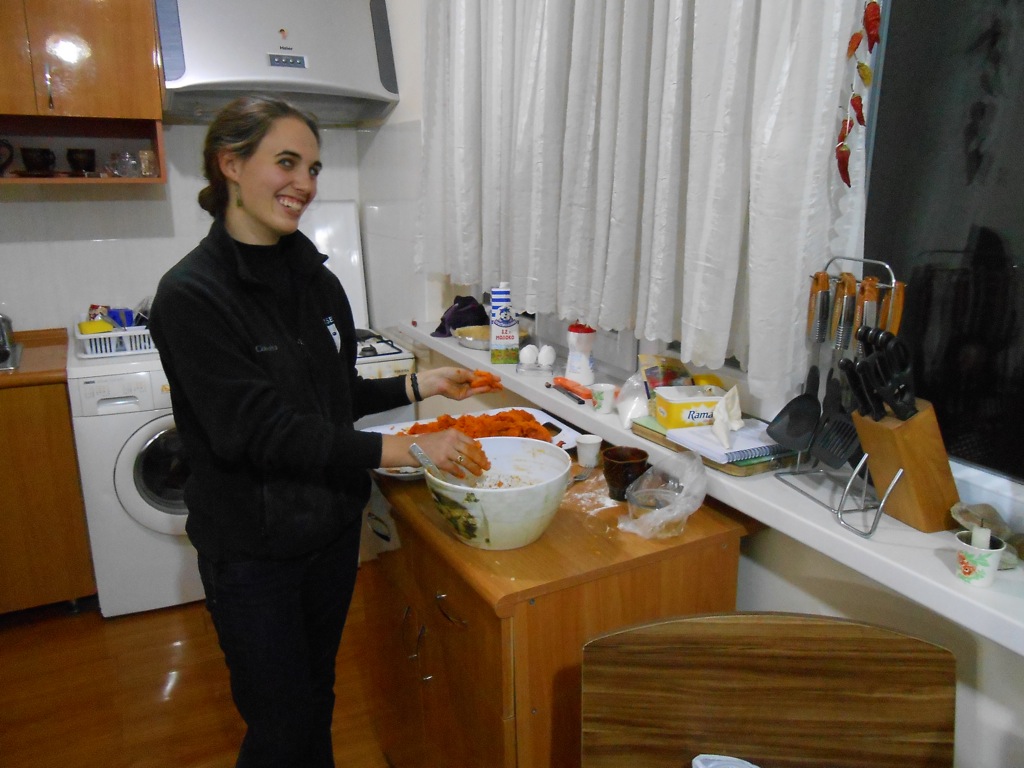
The beginning of the pumpkins.
The night before, making many pumpkin pies.

To make more pie pans I had to take apart frying pans.

Note the tupperware full of roasted pumpkin seeds.

Apple pie beginning in the morning.
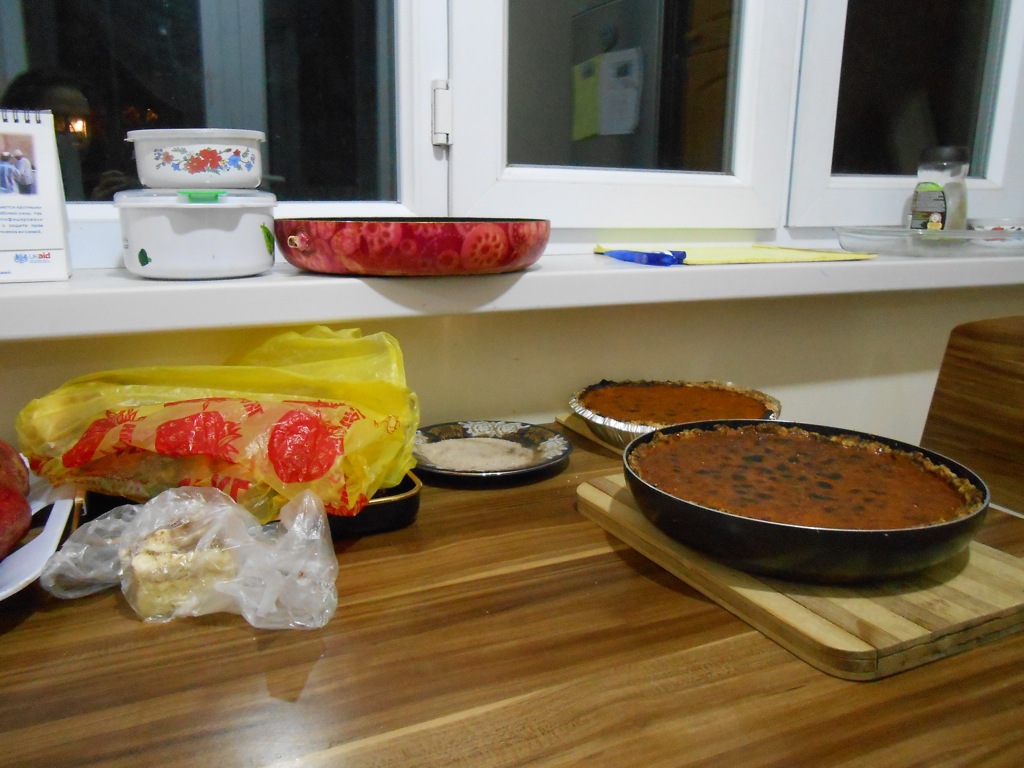
The final pie display.

I didn't take photos of the turkey because my hands were too covered in raw meat juice. 

Running back and forth with pies and turkey all day was good exercise for my biceps. At the end of the cooking, we ended up piling into a taxi to take it to the home of the dinner. 

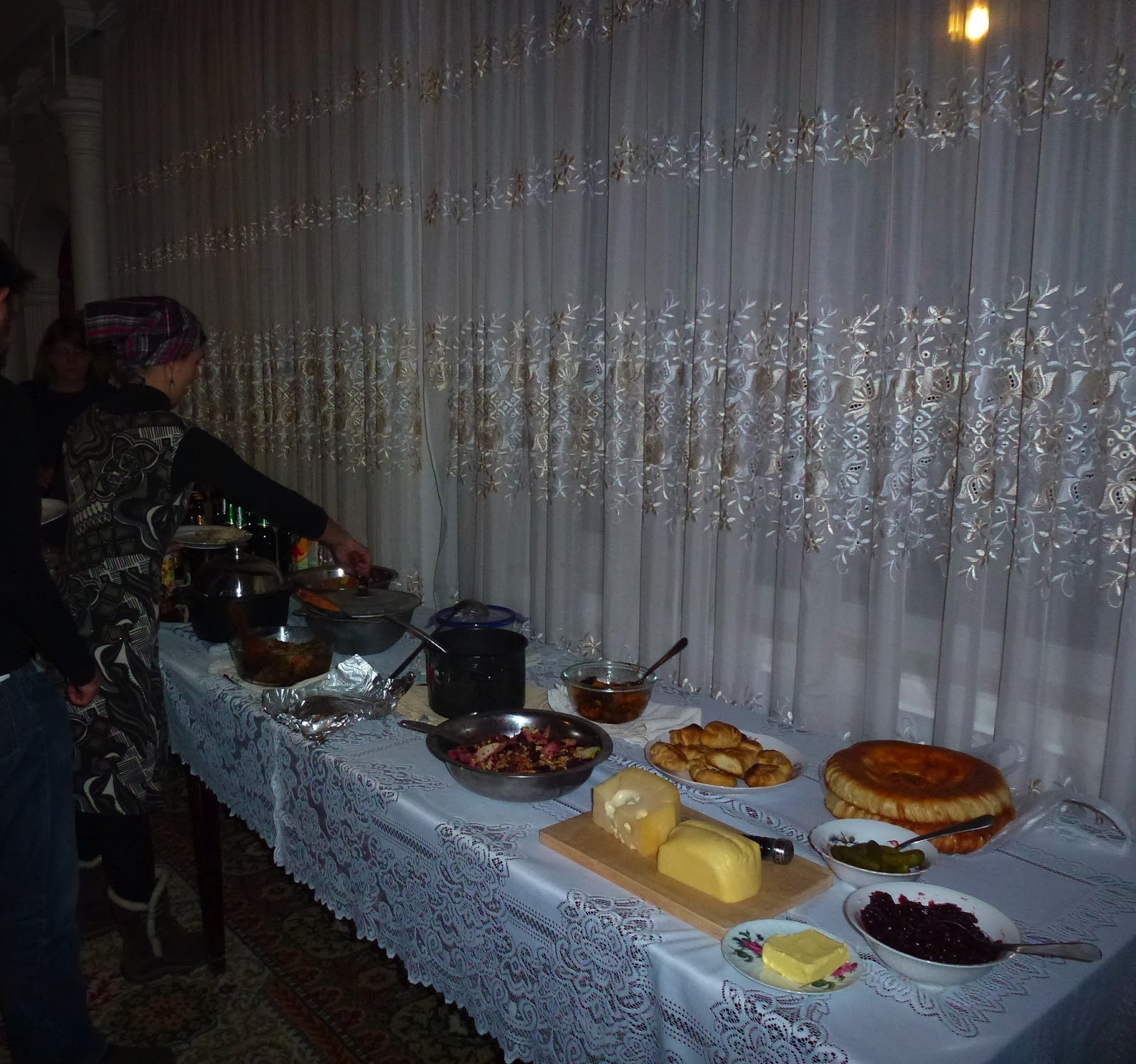
Serving myself from our buffet.

Finishing the gravy in the other kitchen.


Our meal included mashed potatoes, cranberry sauce (imported from America via a Canadian living in Bishkek's boyfriend), salads, mulled wine, and Canadian Beaver Tails along with the pies for dessert. Our feast fed fifteen people: 5 Brits, 4 Americans, 2 Canadians, 2 Tajiks, 1 Austrian and 1 German. Sara was particularly excited that one of the Canadians was a real Mountie. I inflicted the non-Americans with a dramatic re-telling of the Thanksgiving story (though they were lucky, because Sarah and I considered making them do a play). We went home at the end of the night exceedingly thankful, and happy to have celebrated in style.


Monday, October 29, 2012

Abraham's Stars; or Many Holiday Thoughts

Friday was Eid-i Qurbon (Иди Қурбон), known elsewhere in the Muslim world as Eid al-Adha (adha and qurbon are both Arabic words for sacrifice, the later used in the Persian world). Somehow amongst all of the times I have heard and read about Ramadan and Eid al-Fitr, the second great festival of Islam escaped my notice. Tajikistan has helped me rectify that omission, by hearing about Eid-i Qurbon from Tajik friends, and reading about it, and experiencing it. Like the holiday, this blog post encompasses too much: celebration, language, giving, religion, contradictions, traditions, vacation and family.

I asked the American Corner Coordinator, Madina, to explain it to me. She explained that it is the "Feast of Sacrifice," celebrating Abraham's near sacrifice of his son, and thus passing his test of faith. It is the end of the Muslim year, and the time when people go on Hajj to Mecca. The festival always two months after Ramadan, and so cycles about eleven days earlier each year. Some people fast for ten days before Eid-i Qurbon. During the holiday, people spend time with their families, and visit older relatives. Those who are able should sacrifice a sheep, and share the meat with family, friends, and those less fortunate.

When a thirteen-year-old on student said "Congratulations on our holiday!" Thursday morning, I explained that though "Eid-e mubarak" does translate "congratulations," that's not usually what we say in English. We like to say "Happy [insert holiday]," or "Have a good holiday." Imagine my delight when I learned later in the day that many people say "Иди нагз гозарид (Eid-i nagz gozareed)," which translates almost exactly to "Have a good holiday."

On Thursday afternoon, I spent time with some American Corner volunteers taking food to families in need. One of the volunteers had been inspired to put out a donation box earlier in the week, and on Thursday the money was collected and taken to the grocery. They came back with flour, rice, buckwheat (grechka), sugar, oil, black tea, soap and shampoo. We grabbed at the items hastily to put together fourteen bags in the road behind the taxi so we wouldn't have to lug the food to the Corner on the fourth floor. Five of us piled into the taxi to look for the homes on the list that the mosque had provided. The others joined us later via mashrutkeh and walking. As we walked to a house, we played the "What is this in English/Tajik?" game ("Sunflower" is офтобпараст - oftobparast - lit. sun-worshipper, which is delightfully similar. We spent ages as they tried to explain to me a small bird is in the hopes I would know the English name.). The experience was entirely similar to Thanksgiving and Christmas volunteering run by schools and churches at home.

I first heard Abraham's story at church when I was young: God tested Abraham's faith, asking him to sacrifice his son. Abraham was ready to cut Isaac's neck when an angel appeared to stop him and he sacrificed a ram instead. Since he has passed the test, God made a covenant with Abraham: he would have as many descendents as stars in the sky.

When I heard the story in church it was mostly upsetting ("Mom, would you kill me if God asked you to?" The answer better be 'no'). Of course that is exactly why it is a powerful illustration of faith.

But I got a very different reading junior year in a seminar entitled "Bible as Literature" with an inscrutable old professor named Leslie Brisman. It was a secular class based in the English department, and involved comparing different translations and discussing the text in relation to the documentary hypothesis of the Pentateuch (four different authors). Brisman delighted in surprising us with literary analysis, and I particularly remember his explication of Genesis 22. If there are different authors, one intends the story's moral much as I first understood it: God sends his angel to stay Abraham's hand. Another reading - if verses 11 and 12 are excluded - is that an angel did not appear, but the ram did, and Abraham took advantage of its presence to sacrificed it instead of his son. The moral of this story is not blind obedience but ingenuity and problem-solving in the face of a difficult task; can he obey to the extent that is reasonable, and figure out when not to obey.

I was interested to read (a translation of) the passage in the Koran. I had heard that it is Ishmael who is nearly killed, not Isaac, but figured the message is the same. There is an interesting twist, though: Abraham actually asks his son whether he is willing to die. Ishmael agrees, which is seen as a sign of his own faith and maturity. The faith of both father and son is important. This is in contrast to Genesis' Isaac, who seems to be ignorant of what is going on, though smart enough to catch on to the fact that something is not quite right since he notices that there is no sheep as they are headed to the sacrifice. Abraham basically lies and tells him not to worry about it. Both versions of Abraham show him as a father to one boy - in one personal and emotional moment. This is more relatable than Abraham, Father of Three Religions. The scripture gives a story which is then layered and refracted through the rituals of Hajj and Abraham's vast legacy; this is a time to celebrate.


I experienced the celebration on Friday mostly as a holiday in the British sense; no work or school. The streets were quiet without the gangs of black-and-white-uniformed children. Somon bazaar was closed. It rained for the first time in the months I have been here, which led to Sarah and I sleeping in and then making a luxurious breakfast of crepes (banana and nutella) and American coffee. The afternoon was clear and chilly, but not cold. So we went out on a walk, and realized that fall has come as we walked over fallen leaves and past yellow trees. We walked over the river and through the mosaics to Ismoil Somoni's statue.

I was obligated to take photos for my parents and my local coffee shop. My parents sent me the coffee via a coworker's husband's visit to Dushanbe and then an Embassy delivery north. The coffee is from Misha's, the Alexandria coffee shop  that my dad and I visited every Saturday morning from when I was three years old through high school.  On their fridges, Misha's posts photos of people holding their coffee cups in far away places. I would like to think I have made some sort of record.

I held a cup from home and it felt like a fall holiday, so Sarah and I started talking about our Thanksgiving traditions at home. For our Thanksgiving holiday here, we plan pumpkin pie and a bird and some cranberry sauce via Bishkek if we are lucky. Perhaps even some American Football - we have a ball at the American Corner. I can practice being thankful for what I have learned and had time to think about, and plan for how to explain our own holiday in its own glory of story and history and contradictions and tradition all wrapped in language.

Sunday, October 28, 2012

Fall Food

I procrastinate by baking, and have done so since high school. I have a sweet tooth, and baking is my way to both satisfy that craving and feel that I have accomplished something tangible (and edible). These are the products of feeling restless and unprepared to sit down and plan lessons.

This pumpkin bread is cooling by shells from the Tajik Sea, which is what people call the Kairakkum Reservoir. Pumpkins are available in abundance here, though they are not always the perfect round and deep-orange pumpkins from home. Many are elongated gourds of a lighter hue, or fat, ridged beasts streaked with green. The only problem with the pumpkin bread was that it doesn't use much pumpkin, and I had to make another batch. This was the second loaf, more successful than the one made before we found nutmeg. 


I have made several apple pies, since there are so many apples here. This quintessentially American recipe travels well to Central Asia, where apples originated, and was happily consumed by folks from Europe. Though usually pies are seen as part of old family traditions, the source of my pie-making is not my parents or grandparents but my camp family. I think of West Virginia as I cut butter into the dough.


Yesterday I had a sudden desire for scones, so this morning I got up and made some, even though I knew we were also making pancakes at 11. Our oven can be temperamental, so I was glad that these turned out beautifully browned, baked all the way through without burning. I ate my first drizzled with raspberry preserves made and given to us by one of Sarah's friends. The others were eaten with the apple syrup I made to go on the pancakes. I had to take their photo with the tree behind them; I have loved the yellows appearing this week.