Showing posts with label expats. Show all posts

Saturday, November 24, 2012

Khujand Thanksgiving


I considered writing a play along the lines of the First Thanksgiving plays we make Elementary School children do; then I thought about writing a recipe for our Thanksgiving. Instead this blog post is going to end up one part teaching reflection, one part food blog, and one part social report. 


At the American Corner, on the Tuesday before Thanksgiving, I used my regular Discussion Club to make everyone think about what they were thankful for. We also listened to part of a TED talk roughly about being thankful (or appreciative). 

Reading a First Thanksgiving play.
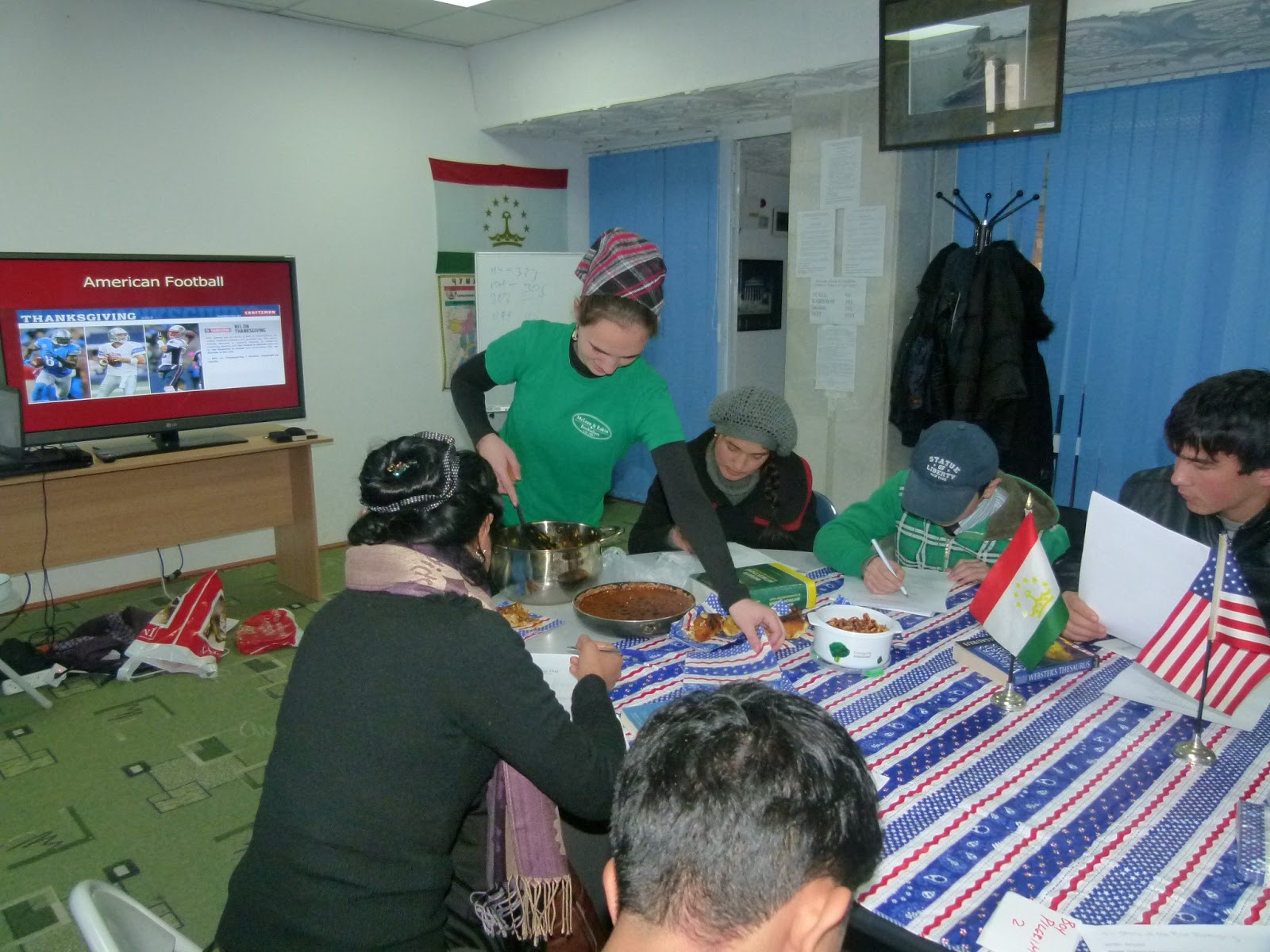
On the day itself, I gave a presentation that went through the basic historical facts, and then I made them read through a simple Thanksgiving play. This is a real American Cultural experience, because it really is what all American schoolchildren do. It was an interesting decision of how much to include, and to look at different websites that advise teachers. I think that public history is fascinating and important, so I started with the basic story: which, again, is what Americans get, and even if you learn more later, it is the narrative that we are celebrating as a country. Every country shapes its own story of itself - Tajikistan very obviously at the moment with Somoni - and the idea of the Pilgrims is an important part of our identity. I also mentioned the Virginia Company, and how it was different; and that things weren't always so happy at Plymouth - you know when the kid in the play says he's hungry, Mom? That's because half of them died that winter. And, right, all of the killing and deaths. But because I wanted to talk about the holiday today in America, I moved on fairly quickly. I talked about food, football, and in my family, the Alexandria Turkey Trot. I served Pumpkin pie.

Cutting the pie while they fill in Thanksgiving crosswords.
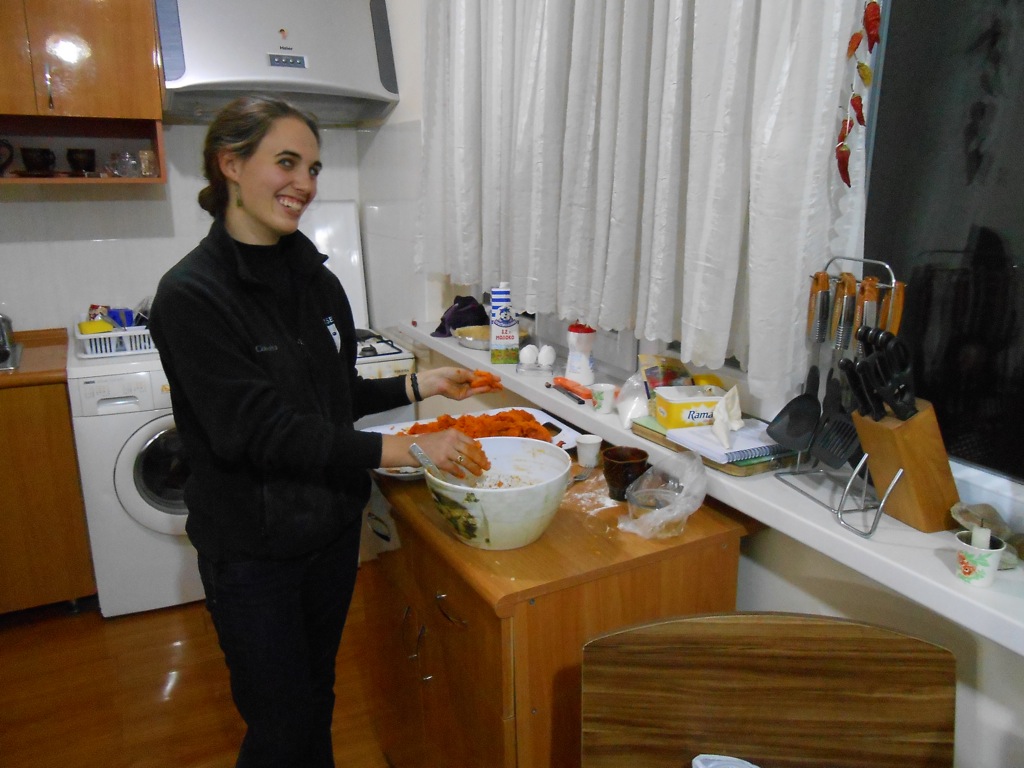
Then I ran home, where I was in the middle of cooking a turkey. I was very proud of this turkey, given my lack of experience with meat as a vegetarian for six years. We were very excited to find frozen turkeys; my friend came upon them and seized them both, since they are rare birds. We cut off the necks together in the morning, and she cooked one while I did the other. I was thankful throughout to my boss at the Embassy. She gave us the cookbook that she and her husband wrote in the Peace Corps in Ukraine, which has helpful things like how to cook a Thanksgiving turkey in a finicky oven and without access to fancy ingredients.

This is where the blog will take a turn towards photos of the cooking:

The beginning of the pumpkins.
The night before, making many pumpkin pies.

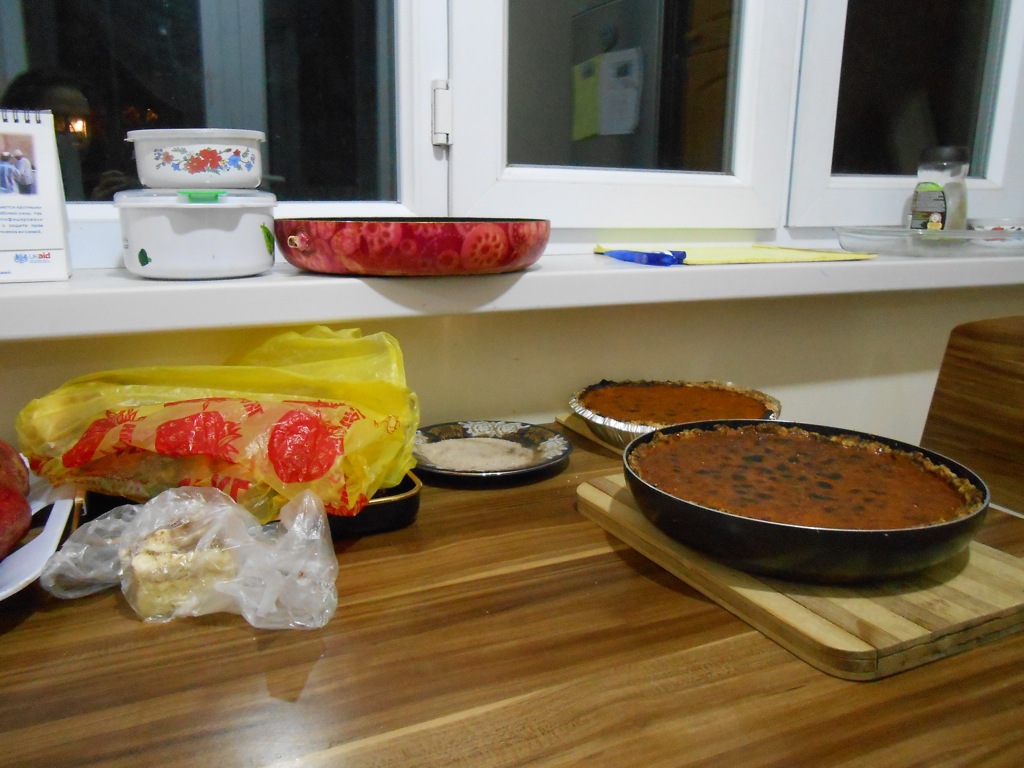
To make more pie pans I had to take apart frying pans.

Note the tupperware full of roasted pumpkin seeds.

Apple pie beginning in the morning.
The final pie display.

I didn't take photos of the turkey because my hands were too covered in raw meat juice. 

Running back and forth with pies and turkey all day was good exercise for my biceps. At the end of the cooking, we ended up piling into a taxi to take it to the home of the dinner. 

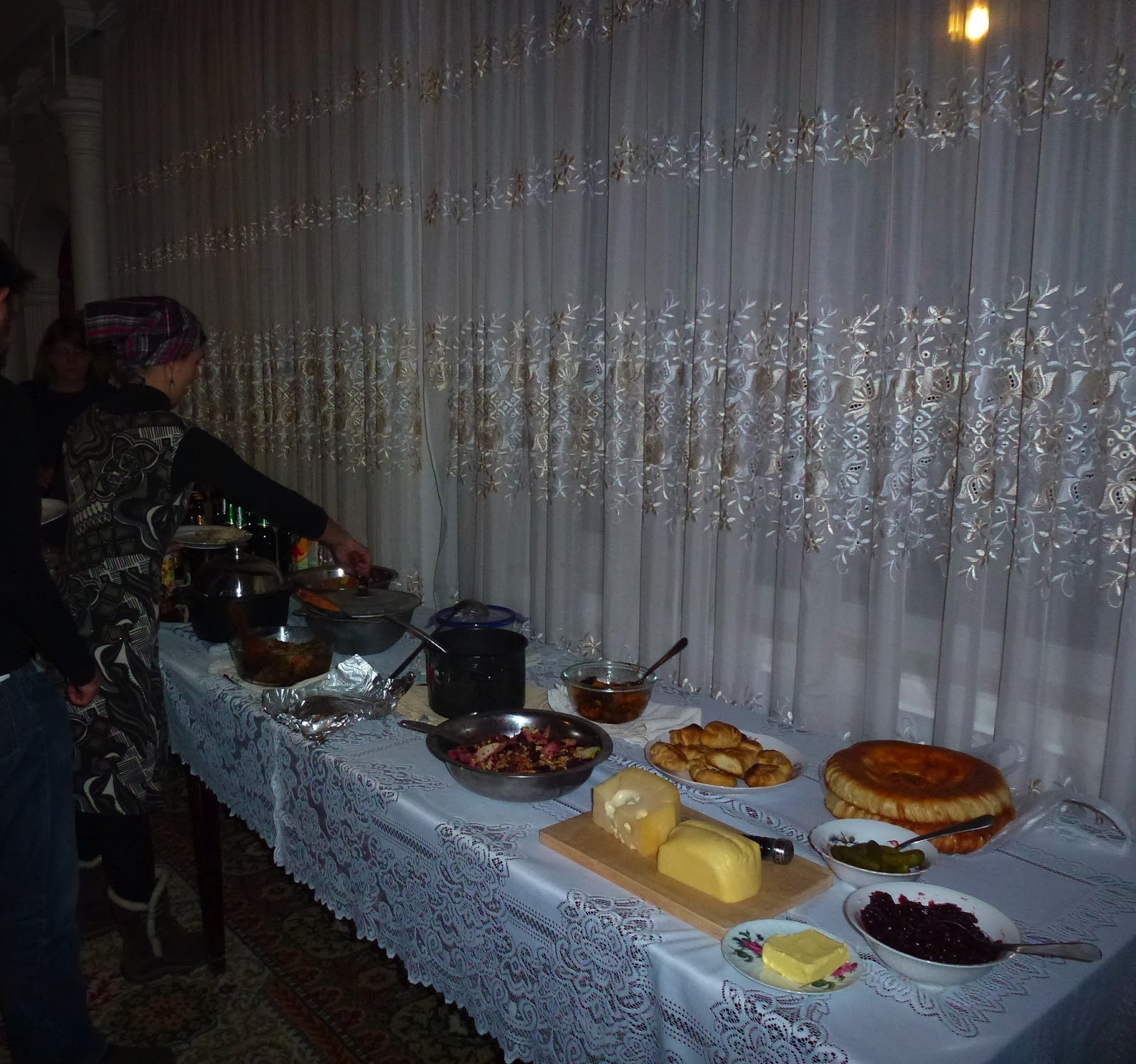
Serving myself from our buffet.

Finishing the gravy in the other kitchen.


Our meal included mashed potatoes, cranberry sauce (imported from America via a Canadian living in Bishkek's boyfriend), salads, mulled wine, and Canadian Beaver Tails along with the pies for dessert. Our feast fed fifteen people: 5 Brits, 4 Americans, 2 Canadians, 2 Tajiks, 1 Austrian and 1 German. Sara was particularly excited that one of the Canadians was a real Mountie. I inflicted the non-Americans with a dramatic re-telling of the Thanksgiving story (though they were lucky, because Sarah and I considered making them do a play). We went home at the end of the night exceedingly thankful, and happy to have celebrated in style.


Sunday, September 16, 2012

Postcard from Kairakum

Greetings from the Tajik Sea!

Tajikistan is a landlocked country, but people often call this large reservoir a sea. Sarah and I went with a group of other Khujandi expats (including two who own cars) to Kairakum on a lazy Sunday afternoon. We sat on a concrete tapchan/gazebo (I think there were dried corn stalks as the thatching) and ate and talked. A few of us wandered down to the sea and went swimming. The water was fairly warm; apparently the water is several meters lower now than it is in the spring, after the rains.

So we'll have to go back in the spring to see the water at its true height!

Kyle


I had to add this photo of my foot hanging off the tapchan to show how much watermelon we are and how the seeds were.

P.S. Kairakum was created with a dam on the Syr Darya River to irrigate more fields of cotton. I had to find out when it was built, because no one with us knew: 1956-58. It is 55km long and 20km wide at its widest point, covering an area of 513 km squared, an average depth of 8.1m, with its deepest point at 25m.

Saturday, September 8, 2012

Do You Have a Family?


On one of my first days in Dushanbe, a young man asked me, "Oyleh dareed?" [Do you have a family?] I answered, "Of course. My mother and father and two brothers are in America." "Na," he responded, "Shohar dareed?" [No - Do you have a husband?] This is one of the first questions that people ask here. There is only one word for family, but when you are old enough, "family" means "your own family with husband and children because you should be married by now and if not you should marry a nice Tajik boy."  For me, "family" means my relatives in America, and it also means my friends here, who are my Tajik family.

My family in Dushanbe was obvious from landing: myself and the three other ETAs arrived on the same flight and stuck together from then on. Embassy workers often commented on how we were always together. When we went to a talk with students in Qurghonteppa, one of them asked, "How long have you known each other?" We thought about it - we had been together in the country for a week at the time, but we met in Austin, TX, in June for four days - "Three months?" "I thought you had known each other since childhood," the students responded.

ETAs, our embassy contact person and one ELF get silly during a long photo-shoot evening.
Our mother - or Fairy Godmother, depending on the day - was the woman that Areebah and I stayed with for two weeks. Shafoat is a local embassy worker who let us sleep in her daughter's beds, lent me her clothes (and gave me some), cooked for us and taught us to make sambusas. Areebah and I stayed up late talking to her about Tajikistan and America, education and healthcare, college and her daughters: one sixteen and indecisive, one eighteen and now a Freshman at Goucher College in Baltimore. Shafoat was our host, our guide to the city, our friend, our mother, as well as host to the other ETAs and ELFs for frequent dinners, inviting over her other friends from the embassy and generally easing our transition into the country.

We put the "bright" in Fulbright.
Leaving Dushanbe was unexpectedly sad because I felt like I was leaving this family. Now in Khujand, I have a smaller family so far: Sarah, an ELF (English Language Fellow - her ears do not seem to be pointy). She arrived a week after the rest of us, but was just as much a part of our pack in Dushanbe. We were glad to find that we liked each other enough to propose: "Hey, I just met you, and this is crazy, but do you want to live together, maybe?" We both enjoy singing, and have become something of a traveling minstrel show. On our way to Khujand, we stopped at three English classes, and ended up singing "Leaving on a Jet Plane." After the first one, we brought the guitar in (we bought the guitar in Dushanbe). Our apartment is beautiful, and we are glad to have each other to talk about our impressions of our jobs and the places we go and the people we meet.


We took this picture to advertise how ready our home is for visitors - 
particularly for our family spread elsewhere South in the country, but also for others.