Showing posts with label ETA. Show all posts

Tuesday, May 7, 2013

Debate (Part 2) and a Postcard from Kyrgyzstan


I said before that I cared more about my students in Khujand than the tournament that was to come in Dushanbe. That was before we went to Dushanbe for the First National English Debate Tournament (March 29-31). I still am proud of what we did in Khujand, but being with students from all over the country brought it to a new level. Granted, there were many differing levels of debate experience and ability, but the excitement of a tournament - with four preliminary rounds in which everyone would compete - was motivation to make all of them improve immensely.
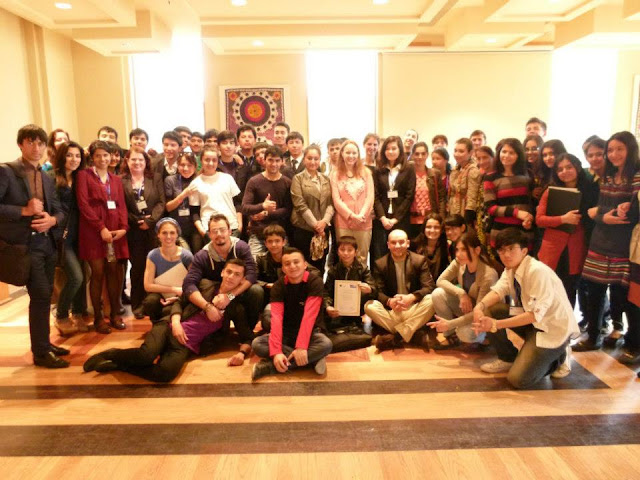
I was staying with the main organizer, and was part of the late-night planning and anxiety about making everything run smoothly. I was one of the judges; I (hilariously) gave the orienting/rules presentation to the debaters while the judges were meeting; I ended up giving out the certificates at the end. The whole thing took place at the gorgeous Ismaili Centre, which made everything more graceful. I enjoyed the planning and the executing and the walking around with my students in the city and the talking in the car through the snow on the seven hours back home. 
There are plenty more photos where those came from; and the video that Areebah and I finally had time to make - a version of the presentation we did in Nepal for future English teachers.

Of course, pretty much as soon as we put it together, we realized how little we knew about international debating and learned a whole lot. We made it to the Asia Youth Forum, after a flurry of calls to parents about permissions and passports all during and before and after the tournament in Dushanbe.

I will let IDEA describe it:
The Asia Youth Forum, one of many regional versions of the IDEA Global Youth Forum, is a two-week experience that combines the Karl Popper Debate Championship, educational tracks (including our Mixed Teams Track which brings students from different countries and different levels of experience together in a peer-to-peer learning experience) and tournaments that allow the speakers to put their newly-acquired skills into practice. Find out more at ayf.idebate.org
This year, AYF was at Lake Issykkul in Kyrgyzstan - but we were more in Debate-istan than Kyrgyzstan. They ran a full schedule for the kids, who learned a lot. They had to really work and prepare for their cases - I'm not sure I would have the intellectual stamina to prepare again and again on the same topic in another language. I joined them the second week, for various reasons, and so entered this culture with full awareness of my ignorance and a bit of trepidation. I was glad to see my students, and intrigued by the trainers and coaches. The Tajik students did really well; one of my students from Khujand made it to the Semi-Finals in the Mixed Team Tournament, while the winning team included one student from Khorog and one from Dushanbe.

This was where we were staying. Yes, you should visit Issykkul.
There are too many photos to count: the Russian IDEA Facebook page, all of my students' Facebook posts, the Asia Youth Forum website. They also interviewed people on what digital freedom means to them and in their countries, and my video is one of the ones that has been posted.  More importantly, the talent show hit "Debate Me, Maybe" has reached YouTube - again courtesy of Areebah's editing.

The view from our room.
Because there are few flights in Central Asia, we had to spend two nights in Bishkek before flying back to Tajikistan. It was fun to compare the city to Dushanbe. The same streets! The same buildings! The same monuments! Only it's Manas instead of Somoni. And their flagpole is pitiful. But Bishkek in general is so much bigger, there's so much more Russian, and so many more restaurants. We went to Sierra Cafe and couldn't stop gushing about how much it felt like America (it's more than the coffee - it's the atmosphere with the bookshelves and the baristas and - I'll stop). We had Texas-style BBQ for dinner.  Our guide to all of this was a Bishkek ETA, and we saw a bit of Bishkek with him: his university, the new mall, TSUM for gifts, attempts to visit closed-on-Monday museums.

We returned home on April 23 to TV cameras at the airport - and then a long drive to Khujand, with one student asleep on each shoulder in the middle seat of the taxi. According to their presentation yesterday at the American Corner, they not only made friends that they left with tears, but also learned about the roles in Karl Popper, what clash points are in a debate, more ideas about Digital Freedom than they ever thought to have, the importance of team-building and sportsmanship, and how to communicate with people from other countries when it is difficult. That's a success to me.

Saturday, December 22, 2012

Notes about Nepal

Nepal was amazing. My overall impressions were "Color!" and "So Many People! (including Tourists!)" I have never been to South Asia, and this was a fascinating introduction. 


I was skeptical before we went:excited to go (on the State Department's dollars), but also confused about what we were going to be conferring about and how it could help us. In the end, it was mostly an opportunity to talk with our compatriots in other countries. 


Hike on our third day: from Telkot to Changu Narayan.
We were technically attending the "Fulbright South and Central Asia Regional English Teaching Assistant Enrichment Seminar." It involved not only the ETAs, but also teachers leading sessions on teaching skills and tools, some of which were very helpful (I was inspired by an energetic and wily older British woman who has been an English teacher in Nepal for over 30 years; one potential future self).

The Tajik ETAs strike a Lenin pose in front of a view on the hike.
We spent all week talking about our teaching experiences - the difficulties - and bragging about our host countries - why you should come visit us. For some it was a mental health break from hard posts. For us, it was an exciting window into other cultures. In the words of one of my colleagues (sorry, a common word here): it was a good kick in the butt. Though our experiences are so different in different countries, so many of the other ETAs were inspiring, or at least exciting to get to know. 

One of our teaching sessions with a Senior ELF in the courtyard of our hotel.
There were 40 of us: we four from Tajikistan, two each from Kazakhstan and Kyrgyzstan, and then eight from our Nepali host country, four from Bangladesh, five from Sri Lanka, and fifteen from India. We were all together during our Pre-Departure Orientation in Austin last June, but we were also grouped with Sub-Saharan Africa, and countries tended to flock together, so I don't remember meeting anyone in the India group. We are all at different stages in our grants: the India group left the U.S. two days after our Austin meeting, while the Bangladesh group haven't even started teaching yet. Even more diverse are our teaching placements: Tajikistan is the only country where ETAs are not placed in schools. Elsewhere in Central Asia, they are in universities as well as American Corners. In India and Nepal, they are placed in elementary school classrooms, often with classes of 50-70 kids, dealing with first-graders and 10th-graders. So our teaching challenges are very different. But sharing was still worthwhile. 
Areebah and I gave a presentation on Debate in Tajikistan. Others 
presented on different classroom techniques and challenges.
We felt a responsibility to let the rest of the conference know that Tajikistan exists. We started our presentation acknowledging that no one in America knows it exists.  I also put forward a (fragile) hypothesis that we are the fulcrum of cultures that makes sense of South and Central Asia together. We are closer to the rest of Central Asia and the post-Soviet culture, but the Persian language and culture connect us to South Asia and via language (Urdu is heavily influenced by Persian) and visual culture (i.e. clothing: Tajik kurta and izor are similar to shalwar kameez).


Tajikistan group presentation with the slide showing the above link.
The conference was technically only four days: Monday-Thursday. We were supposed to arrive Sunday and leave Friday. But, of course, there are not many flights from Central Asia, so we had to arrive Saturday (which meant leaving Dushanbe Friday, which meant leaving Khujand Wednesday night to make sure I arrived in time). Then we wanted to spend extra time, as long as we were flying such a long way, so I stayed until Sunday, and the other Tajikistan ETAs decided to stay until the next Wednesday. [In the end I arrived back at the same time as the others, due to my travel glitch.]

A Nepali (Buddhist?) traditional parting gift during our closing ceremony.
The four Tajikistan ETAs.
It was also a luxurious vacation: I had real coffee most days, and there was WiFi available for friends with smart phones. Food was made for us. We talked furiously the whole time in real, fluent English. I went to a movie theater, where I saw Life of Pi in 3D (and it was amazing) (and in English). I spent money on souvenirs in Thamel, the shopping area fiendishly cheap and enticing. An area I actually wanted to shop: scarves, warm woolen things (pashmina, cashmere), and handmade paper goods (stationary! journals!). I got to see tourist sites and learn about cultures I know nothing about. I learned about Hinduism and Buddhism - or just the hints at how little I know, and how little of the temple iconography I understood. 

Holiday Card photo at Bhaktapur.
The photos are mostly from our more touristy excursions: Boudhananth, a Buddhist stuppa where I couldn't stop myself buying two thanka (Buddhist paintings), Pashupati, where Hindus burn their dead, and Bhaktapour, an old city nearby filled with temples. Areebah and I also went on a plane flight and saw Everest. I could say more about all of them, but this is already too long - I recommend going yourself.

Boudhananth stuppa.


At the thanka workshop next to Boudhananth.


At Swayambunath when it got cold, with a new scarf.
At Swayambunath.
View from the plane. Everest is the pyramid-shaped peak in the back-right. What was amazing was not so much Everest as the many mountains that are nearly as tall, and the many peaks down below the clouds.


Everest is the pyramid-shaped peak in the back-center. Apparently these flights don't have the best safety records, but we just had to do it.
Because if you didn't get a certificate, then it didn't happen. This is something we see a lot here, so Areebah and I laughed to be given certificates after our 6 a.m. flight. (Yes, it is "Yeti Airlines".)
[More photos of Nepal from my friends are on Facebook, since I am bad at remembering to take photos]