Thursday, January 24, 2013

Five Months


On Sunday I submitted my Mid-Year Report, which is required of all Fulbright grantees half-way through their grant period. Which means that it has been five months since I landed in Dushanbe, and now there are less than five months left. All of a sudden, ten months seems not long at all, and I realize that I will soon be one of the Sharons and Davids that people here remember coming and leaving. 

Marking January 1st - while fun - was not as meaningful to me. I still measure my life in school years. If I am to measure by calendar year, then I should be reflecting on all of 2012: writing my senior essay and hanging out in our common room and graduating and the Cove and Tajikistan. It is a colorful and exciting collage, but not a cohesive whole. Rather than making New Year's Resolutions, I have made Fulbright Resolutions, or perhaps Fulbright Realizations: what I have realized since August 20, and what I plan to realize by June 13, when I fly back to the U.S.  

My Fulbright Renewals are the result not only of realizing I am half-way, but also the result of returning after a month of traveling. First to Nepal, then return-trip detour to Almaty, then back in Khujand for a week of winter, then to Italy, where I met my family and celebrated Christmas. I arrived again in Dushanbe on New Year's Eve and came back to Khujand three days later when my baggage arrived. 

I was met at the American Corner by a flurry of students finishing their applications for the Global UGrad progam. I was swept into essay-reading and turning away reference requests. In the three weeks since, I have made myself much busier than I was September-November. I now have morning classes, instead of lazy planning sessions. One is my new series of TOEFL preparation trainings (the American Corner as a Public Organization is not legally qualified to teach 'classes,' only provide 'trainings'). That involved a sign-up, a test to scare people away, and fighting away late-comers. I also have a "Reading Club" (read-aloud time) and a Hunger Games book club. I am teaching an advanced writing workshop (we are working on essays, starting with a biography - think middle school). I am trying to start a competitive debate club, rather than my open-to-all debate/ activity/ discussions. I have had extra classes with visiting groups of 30 kids each from two different nearby towns. I have put a lot of time into thinking about how to teach about Martin Luther King, Jr. and the inauguration.

I have benefited from taking to heart another ETA's self-identification as an after-school programmer rather than a teacher. Extracurricular is a better word: you cannot be 'after school' if there is no school. The government declared there would be no school in January this year because it was supposed to be too cold to heat classrooms - something that does not happen every year, but did happen last year. University students are either in exams or on break. The American Corner is crowded. 

This means I come home more tired and stay up late planning - but now I have real coffee to help me get up in the mornings. And when I am teaching, I am moving and thus warmer than sitting in one place. 

January has been milder than (the one week I saw of) December, but it is still cold. My winter wardrobe includes a scarf every day - worn tied behind my head with the ends hanging - plus leggings, pants, turtleneck, sweater, coat, gloves. All of those are worn inside as well as outside. It used to include black boots, but the heel broke and I haven't had time to take it to the cobblers at the bazaar (they fixed both zippers on the same boots for 5 somoni). 

Our water is not the most reliable: pipes have frozen twice, and the pump stopped working once, but now it just ebbs and flows throughout the day so sometimes we have to turn on the pump to get any warm water or even to get enough to wash the dishes. 

I eat a lot of soup. I made some delicious braised cabbage this week. I try to remember to get vitamins somehow, even though vegetable selection is sparse and I forget about the fruit when it is not shoved at me (apples are now 7 somoni a kilo instead of 1 somoni/free in buckets in the fall). I drink a lot of honey-and-lemon. Lemons here are large and sweet and more lemon-y. 

More plans to realize: See a game of buzkashi. Celebrate Navruz exuberantly. Go hiking. Use my binoculars and my new Guide to the Birds of Central Asia. Try to learn more Tajik music. Actually study Tajik vocab. Spend more time with people. 

The hardest questions for me to answer in my mid-year report were in the "Cultural and Social Adjustment" section. 
  1. What were your strategies for getting acquainted with the people and the culture? 
  2. What kind of changes did you make in order to adjust to the local culture?  

"Were," "did;" do they mean that my adjusting is all in the past? I am comfortable here, and I think I often know what to expect, so in that sense, yes. But while I might be "adjusted," I am merely "acquainted" with people and culture, and I agree - I do not feel that I know much of anything. I ended up answering in the past tense what I was really meant as directions to my future self for the rest of my time: Be available and present with people.  Listen more than I talk. Work on figuring out when and how to hang out with people. Continue trying to figure out everything.

Friday, January 18, 2013

Mice


Mice are usually good at hiding, and yet recently they have been scurrying their way into my life. Not live ones, luckily; though I do think they can be cute, I had most of my sympathy driven out of my vegetarian heart when part of my job at summer camp was to be "Mousketeer" and set traps to catch the rodents that ate holes in our clothes and threatened the kitchen. I do not welcome them inside, and our apartment here has proven rodent-proof. That does not mean that my heart is hardened to fictional mice.

I have started a new "Reading Club" at the American Corner: I inherited one when I first arrived that became frustrating, since I had to figure out what to read and how much to print since new people would come every time and I wouldn't know how many and what level they would be. So I canceled it, since that is the wonderful prerogative of my position. But at the conference in Nepal, our main presenter emphasized that she believes that reading aloud helps students at all levels. New research supports reading aloud to ESL/EFL students because they can listen to correct pronunciation, not worry about comprehending every word, and understand more than when they try to read aloud themselves (I know I experience this: when I read aloud in a foreign language, I focus on words and my brain cannot also focus on meaning; I have to either read it quietly before or after). I seized upon this suggestion, and decided it could stand on its own. Read-aloud story time in libraries is a time-honored American Library Tradition. And the American Corner is in a Library. And we are all about teaching American Traditions. Most importantly, I really enjoy reading aloud.

I looked through our collection of lower-level books, and considered something like Old Yeller or Sarah Plain and Tall, but settled on The Tale of Despereaux by Kate DiCamillo. It is a recent children's classic and winner of the Newbery Medal in 2004. I was a little older than its target demographic when it was published, but my mother bought it for my younger brother, and I was taken by the hardcover's soft-pastel drawing and the pages' deckled edges, and quickly swallowed the story of the mouse who falls in love with a human princess. I didn't really remember the plot when I picked it off the shelf at the American Corner for consideration, but its fate was sealed when I found a PDF teachers' guide that advertised using it in a class for ESL students, as well as parents' reviews that said it seemed to be written as a read-aloud novel. Participants at the American Corner have now learned the words "scurry" and "despair." [If you would like to learn a new word, mouse in Tajiki is муш (mush), which is comfortingly close to English, but a bit cuter-sounding.] They are still figuring out the graphic organizers I have given them (they didn't seem to want to draw). But I am excited to reach the second section next week, when we learn that the king has banished soup from the kingdom due to a series of events involving a rat. There is true despair in the kingdom over this - and there would be here, too, because soup is an important staple of the Tajik diet (I know a Tajik girl who went to the U.S. for university and wrote home asking for soup recipes to make in the dorm kitchen because she was homesick for soup and couldn't find any).

I took several books from the shelves of the American Corner; one night I read The Tale of Desperaux in bed, and the next I read Maus, Art Spiegelman's graphic novel about the Holocaust. Both have careful illustrations, but the latter took my breath away from darkness rather than light. I had always wanted to read it and was recently reminded of its existence when the ELF in Almaty told me she is using it in her university English classes. So it caught my eye when I saw it here. We have a fairly random collection of books that are mostly too advanced or too specialized for most of the people who come to the American Corner, like 400-page biographies of Benjamin Franklin, or to a book by Julia Alvarez co-written with her husband Bill Eichner. 

But this week Christmas came in the form of hundreds of new books - from Scholastic! It was like book orders in middle school, only many times better - and many times heavier. Several people waited for the truck on Monday, but by the time it arrived there were only five of us left, and it took over two hours to carry all of the them up to the fourth floor of the library in the dark. I carried books, and the boys paired off to carry the new shelves and tables. We still don't exactly know what's in all of the boxes, since the embassy ordered them, but we understand that they are easy books more appropriate for people just learning English, and I cannot wait to find out (maybe Stuart Little is there?). We have managed to investigate the one large box of DVDs, which included many good movies, but I was most excited about An American Tail.

Sarah and I have been talking about showing this movie since September, when we realized that it would be a great way to discuss what it means to be an immigrant and temper the mania for visa requests. It is about the trials of a Jewish-Russian immigrant family to New York in 1885, from getting separated from family to being swindled by rats who take advantage of recent arrivals. And, yes, these characters are also mice. (Wikipedia informed me that Art Spiegelman thought director Stephen Spielberg plagiarized his idea, but decided not to sue.) Before arriving, the family is certain that "There are no cats in America/ and the streets are paved with cheese!", but, of course, there are cats in America. Spielberg makes our hero Fievel Mousekewitz heart-breakingly cute, especially when he and his sister sing "Somewhere Out There." Previewing the movie at home, I was surprised to realize what a little kid Fievel is; I remembered him as my age - which shows that I last watched it when I was about 8. When I showed it yesterday people weren't ready to talk about it, but they did say they enjoyed it - and they stayed until the end, which often doesn't happen when we show movies. 

I went home with another one of the new DVDs, since I have a cold and needed something to curl up with alongside my honey-and-lemon 'tea'. It shockingly doesn't feature mice: You've Got Mail instead has everything comforting that doesn't require thought: bookstores, Meg Ryan, Tom Hanks, and a happy ending.

Mouse update 26 Jan: To keep the theme going, during our Burns Night I read his "To a Mouse, on Turning Her Up in Her Nest with the Plough, November, 1785." I love the image of the him stooping to talk to the mouse - though we also speculated that perhaps his tendency to stop and write a poem instead of continuing to plough his field might have contributed to his failure as a farmer.

Saturday, December 22, 2012

Notes about Nepal

Nepal was amazing. My overall impressions were "Color!" and "So Many People! (including Tourists!)" I have never been to South Asia, and this was a fascinating introduction. 


I was skeptical before we went:excited to go (on the State Department's dollars), but also confused about what we were going to be conferring about and how it could help us. In the end, it was mostly an opportunity to talk with our compatriots in other countries. 


Hike on our third day: from Telkot to Changu Narayan.
We were technically attending the "Fulbright South and Central Asia Regional English Teaching Assistant Enrichment Seminar." It involved not only the ETAs, but also teachers leading sessions on teaching skills and tools, some of which were very helpful (I was inspired by an energetic and wily older British woman who has been an English teacher in Nepal for over 30 years; one potential future self).

The Tajik ETAs strike a Lenin pose in front of a view on the hike.
We spent all week talking about our teaching experiences - the difficulties - and bragging about our host countries - why you should come visit us. For some it was a mental health break from hard posts. For us, it was an exciting window into other cultures. In the words of one of my colleagues (sorry, a common word here): it was a good kick in the butt. Though our experiences are so different in different countries, so many of the other ETAs were inspiring, or at least exciting to get to know. 

One of our teaching sessions with a Senior ELF in the courtyard of our hotel.
There were 40 of us: we four from Tajikistan, two each from Kazakhstan and Kyrgyzstan, and then eight from our Nepali host country, four from Bangladesh, five from Sri Lanka, and fifteen from India. We were all together during our Pre-Departure Orientation in Austin last June, but we were also grouped with Sub-Saharan Africa, and countries tended to flock together, so I don't remember meeting anyone in the India group. We are all at different stages in our grants: the India group left the U.S. two days after our Austin meeting, while the Bangladesh group haven't even started teaching yet. Even more diverse are our teaching placements: Tajikistan is the only country where ETAs are not placed in schools. Elsewhere in Central Asia, they are in universities as well as American Corners. In India and Nepal, they are placed in elementary school classrooms, often with classes of 50-70 kids, dealing with first-graders and 10th-graders. So our teaching challenges are very different. But sharing was still worthwhile. 
Areebah and I gave a presentation on Debate in Tajikistan. Others 
presented on different classroom techniques and challenges.
We felt a responsibility to let the rest of the conference know that Tajikistan exists. We started our presentation acknowledging that no one in America knows it exists.  I also put forward a (fragile) hypothesis that we are the fulcrum of cultures that makes sense of South and Central Asia together. We are closer to the rest of Central Asia and the post-Soviet culture, but the Persian language and culture connect us to South Asia and via language (Urdu is heavily influenced by Persian) and visual culture (i.e. clothing: Tajik kurta and izor are similar to shalwar kameez).


Tajikistan group presentation with the slide showing the above link.
The conference was technically only four days: Monday-Thursday. We were supposed to arrive Sunday and leave Friday. But, of course, there are not many flights from Central Asia, so we had to arrive Saturday (which meant leaving Dushanbe Friday, which meant leaving Khujand Wednesday night to make sure I arrived in time). Then we wanted to spend extra time, as long as we were flying such a long way, so I stayed until Sunday, and the other Tajikistan ETAs decided to stay until the next Wednesday. [In the end I arrived back at the same time as the others, due to my travel glitch.]

A Nepali (Buddhist?) traditional parting gift during our closing ceremony.
The four Tajikistan ETAs.
It was also a luxurious vacation: I had real coffee most days, and there was WiFi available for friends with smart phones. Food was made for us. We talked furiously the whole time in real, fluent English. I went to a movie theater, where I saw Life of Pi in 3D (and it was amazing) (and in English). I spent money on souvenirs in Thamel, the shopping area fiendishly cheap and enticing. An area I actually wanted to shop: scarves, warm woolen things (pashmina, cashmere), and handmade paper goods (stationary! journals!). I got to see tourist sites and learn about cultures I know nothing about. I learned about Hinduism and Buddhism - or just the hints at how little I know, and how little of the temple iconography I understood. 

Holiday Card photo at Bhaktapur.
The photos are mostly from our more touristy excursions: Boudhananth, a Buddhist stuppa where I couldn't stop myself buying two thanka (Buddhist paintings), Pashupati, where Hindus burn their dead, and Bhaktapour, an old city nearby filled with temples. Areebah and I also went on a plane flight and saw Everest. I could say more about all of them, but this is already too long - I recommend going yourself.

Boudhananth stuppa.


At the thanka workshop next to Boudhananth.


At Swayambunath when it got cold, with a new scarf.
At Swayambunath.
View from the plane. Everest is the pyramid-shaped peak in the back-right. What was amazing was not so much Everest as the many mountains that are nearly as tall, and the many peaks down below the clouds.


Everest is the pyramid-shaped peak in the back-center. Apparently these flights don't have the best safety records, but we just had to do it.
Because if you didn't get a certificate, then it didn't happen. This is something we see a lot here, so Areebah and I laughed to be given certificates after our 6 a.m. flight. (Yes, it is "Yeti Airlines".)
[More photos of Nepal from my friends are on Facebook, since I am bad at remembering to take photos]

Friday, December 21, 2012

Winter Wonderland


It is so nice to be home in Khujand. I realized when I arrived that I had missed it. It is so nice to know where things are, and to know what people are saying. It has become true winter. It snowed this week. The library put out carpets along the granite walkway so people don't slip. The supermarket also put carpet on its steps - and I had to step around a stray dog who realized that that was the warmest place he could be. Khujand's winter wind has arrived with it: last Sunday it was "12F, feels like -6F." I am in more layers than I wore in Almaty.

Sorry for not specifying earlier, but the travel home from Kazakhstan was eventually successful. It was not certain: after missing the flight Tuesday, I went to the very helpful men in the USAID travel section, who told me that the Ministry of Foreign Affairs was closed on Wednesday and 'they often take five days to process visas, so you need to be prepared to not make your flight on Friday'. But I did. Of all the potential answers to "everything happens for a reason," the most compelling is that I was meant to arrive in Dushanbe with all of my fellow ETAs. And then I hopped straight onto the plane to Khujand, and spent a very pleasant flight talking to a new friend who even drove me home to our apartment.

Once home, though I was happy about snow, our apartment building was not happy about the cold: we were without water for three days, and the eventual solution involved breaking into the empty apartment next door with a crowbar and holding a hairdryer against the dusty pipes until the water unfroze. Now we are supposed to keep a constant drip of running water to prevent re-freezing (I'm sorry, Burgundy!).

But we could stay warm with my souvenirs and gifts from Kathmandu: scarves for Sarah and Madina, and wool throw blankets for the apartment, which became a stylish shawl when worn to the American Corner. I gave a presentation about Nepal, showing them thankas and rupees and prayer flags. They were excited to hear, and I was excited to be back at the American Corner and to share.

My TOEFL students are my favorite (don't tell), because I actually see them regularly and have gotten to know them. Our last class was on Wednesday, and I had prepared surveys for them to fill out, printed out certificates (with out new color printer!), and made brownies. I was utterly surprised when they had a present for me. It was so sweet, and they were all so earnest in their thanks. They wanted me to know that they appreciated the class, but also that they were thinking of me since I was far from my family for the holidays. The present was one of the decorated cardboard New Year's boxes that they sell in the grocery, with chocolate inside (I think I talk too much about how I like chocolate). Only when I got home did I see their note, written on a 3D Christmas tree card.

Well, not Christmas tree - New Year's tree (in Tajik, archa). I had no idea how much Russian New Year's celebrations and decorations have become part of the Tajik December. In the middle of Lenin street there is a huge tree, which is lit up at night, and a stage behind where there are now concerts every day at 2 p.m. We foreigners see Santa faces on the tree, and tinsel and other Christmas decorations in the bazaar. They see a New Year tree and "Boboi Barfi" (Father Snow).

The courtyard between the mosque and Panjshanbe bazaar currently features a large New Year's tree and several Father Frosts willing to take a photo with you. 

Either way, 'tis the season. The week has been full of talking and dinners: at the Grand Hotel with Embassy visitors, in our kitchen with a neighbor bringing coffee and at a friend's apartment with pasta, tea and decorations. I downloaded albums from my two favorite singers of Christmas songs: Michael Bublé and Nat King Cole. They've been on repeat as I drink Seattle's Best Coffee from our new drip coffee maker.

Wednesday, December 12, 2012

Postcard from Almaty; or Airport (mis)Adventures


I am on my way back from our Fulbright ETA conference in Nepal. I was planning on starting a post about Nepal with something brief about our itinerary: Dushanbe - Almaty - Abu Dhabi - Kathmandu. How amazing and crazy it is that we can fly to three different airports with three different non-Latin alphabets in three days. On the way back, I began Sunday evening with tourists in expensive outdoor clothing in Kathmandu, then flew to Abu Dhabi in order to spend 13 hours in the airport overnight and was a little crazed despite the free WiFi, western coffee chain, and beautifully tiled ceiling. On Monday I flew to Almaty for a 16-hour layover - which is now extended indefinitely, since I missed my Tuesday flight to Dushanbe.

This is definitely the biggest travel mistake I have ever made, whether measured in time (no flight until Friday), money ($300 to switch my flight plus the $195 visa I thought I could get reimbursed for but cannot), or visa wrangling (in few other countries would it be so legally problematic to miss a flight). After being gone for almost two weeks, I had been really looking forward to arriving home in Khujand. I was distraught.

I was most upset about the blow to my pride. Missing the flight was entirely my fault - I was in the airport, at the gate - but the wrong gate, and I realized it five minutes too late. The fact that the flight was held as they called my name and I didn't hear it in their Russian announcement makes it worse. I didn't realize how much I thought of myself as someone who wouldn't do something like this, who wouldn't miss a flight for no reason. Pride comes before a fall.

But people quickly helped me put this fall into perspective. I was reading The Snow Leopard on the plane, and Peter Matthiessen's quest for Buddhism and natural science in Nepal reminded me that I have to accept what is. Others told me that I'm lucky to see another county, to enjoy the adventure, to make lemons from lemonade, and that everything happens for a reason. As I'm still in the lemon-squeezing stage, I'm not yet sure how the lemonade will taste, but I know that I am thankful for the support and the time to stop and think.

I am grateful to the many people who have taken time from their lives - full of other things to do - to help me, including my Fulbright coordinator in Dushanbe, the Fulbright coordinator in Kazakstan, and the travel section at USAID who are helping me to get my exit visa. Mostly I am thankful to the ELF here in Almaty, who has welcomed me into her (warm) apartment and talked with me for hours about everything from teaching TOEFL to how hard it is to shop for pants. Last night she took me to a coffee shop so trendy that I would have marveled at it even in NYC. She drew me a very helpful map so I can walk around and explore.

Almaty is a big city (the biggest in Kazakstan because it used to be the capital). Cars actually stop for pedestrians. Streets are lit at night. Women walk alone even when it is dark. The Kazak bills are so colorful. I know no Kazak and my Russian stops just beyond 'devushka' and 'spasiba', so I have gotten practice at smiling and making hand gestures. To use my English I visited the American Corner, and walked in just as a discussion club was supposed to take place and an American did not show up to lead it, so I did. They told me about Kazak history and holidays. It felt a bit like home, since everyone was so friendly and genuinely pleased to see me.

Today I have had the luxury to sleep, and write, and visit the coffee shop again. It is snowing. It is beautiful as it falls. 

Friday, November 30, 2012

Three Months


November was a month full of events: the election, International Education Week, Thanksgiving, the President's visit (library closed), and Flag Day (concert beginning early Saturday morning and flags everywhere). The government blocked Facebook this past Monday (which made some American news sites; the article on RFE/RL includes a great picture of Zuckerburg (photoshopped?) which Tajiks have been sharing even though the site is still blocked).

In my third month, I have noticed things that I didn't notice before. If my first month was finding my way around and noticing everything new - more like travelling - and my second month settling in - becoming totally accustomed to plov and shashlik and the bazaar and questions about marriage - in my third month I started noticing the little things that I didn't have mental space to notice before, or didn't manage to see: that the nighttime lights on the main street are the colors of the Tajik flag (they are not constantly red and green for Christmas), that our apartment has one flight of 6 steps, then four flights of 9 steps; and that every woman wears a scarf differently.

A rumol is the headscarf that most Tajik women wear. I had noticed the general pattern before: that in the villages, every woman wears one of the headscarves, often brightly colored, tied not unlike a bandana, and that it is less common in the cities. It is not the same as hijab, since it does not cover all of your hair: not so much religious as cultural (and practical if cooking or picking cotton). But only now have I noticed how unique every woman's scarf-tying is: most tie a sort of knot around a bun at the back of the neck, some leaving the ends hanging down their back; some tie the ends back up around the head like a headband; some wrap the ends around their neck; some let the hair hang out the back like a ponytail. Then there are the Russian-style women who tie more like we would a bandana; then the look we associate more with the Middle East of a scarf wrapped over the head and around the shoulder (also associated with women in a convertible), then the old women who drape a large white shawl over their heads and fasten under the chin. Some women do wear hijab: also fastened in an endless variety of ways, but with the tight under-scarf cap that covers all the hair, and careful pins to keep the scarf secure. Their scarves are more often the silk (or fake-silk). Rumol are more often cotton or rougher material. I only started noticing the various permutations when I tried to wear a rumol for the first time. I wanted to wear something on my head, as it has gotten cold.

It is cold, but I am told that it is not yet winter; the wind has not come. Nonetheless, I am in boots every day - usually the black, heeled, fleece-lined boots I bought at Somon Bazaar (who would have thought that Tajikistan is where I would learn to wear heels?), sometimes the brown snow boots I brought from home. My coat is my constant companion, and I love its double layers dearly - though I am also beginning to admire the ankle-length, heavy coats that women here wear. A friend helped me buy a pair of leather gloves, since I forgot to pack something for my hands (50 c instead of 75 because he knew the salesperson). In our apartment we have two air heaters mounted on the walls, and Sarah and I have acquired two more oil heaters; we love them (as you can see in this picture that Sarah took of me the other day). Our beds are the warmest places. 

The American Corner is also warm; I enjoyed my presentations for various events this month, and I have come to love my TOEFL class. Not only my students, who are wonderful, but also figuring out how to teach the class. I felt more comfortable teaching, even as I also felt that at times I burrowed under my covers to sleep. There is always more to do. I think I will change my schedule again after the opportunity to talk to other ETAs in December. I look forward to a cold few months, but also the comfort of a home and increasingly meaningful relationships here. And before the real winter, an exciting December of travel, and the surprisingly strange feeling of leaving Tajikistan (and Khujand) for a little while to do so. 


Saturday, November 24, 2012

Khujand Thanksgiving


I considered writing a play along the lines of the First Thanksgiving plays we make Elementary School children do; then I thought about writing a recipe for our Thanksgiving. Instead this blog post is going to end up one part teaching reflection, one part food blog, and one part social report. 


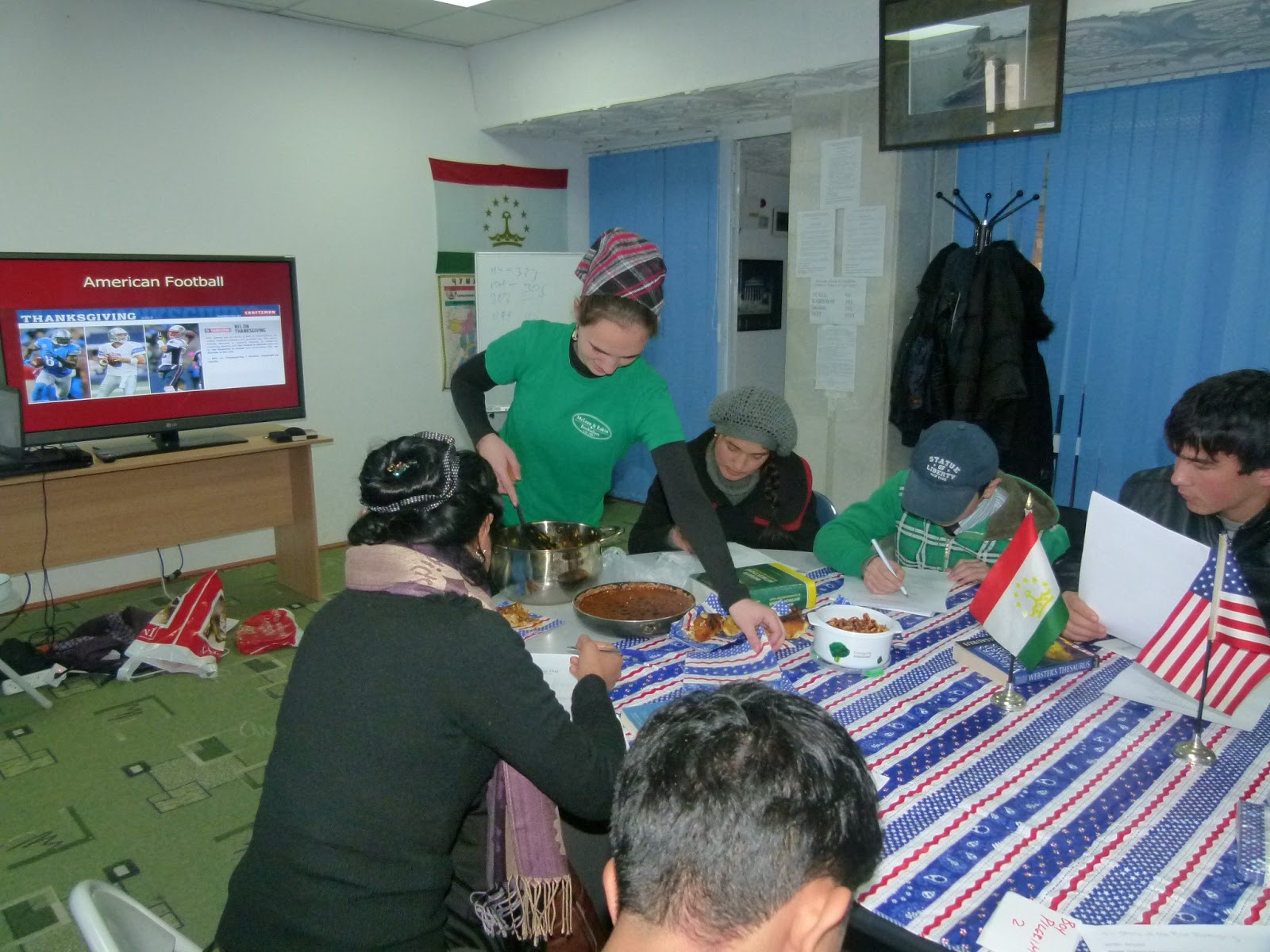
At the American Corner, on the Tuesday before Thanksgiving, I used my regular Discussion Club to make everyone think about what they were thankful for. We also listened to part of a TED talk roughly about being thankful (or appreciative). 

Reading a First Thanksgiving play.
On the day itself, I gave a presentation that went through the basic historical facts, and then I made them read through a simple Thanksgiving play. This is a real American Cultural experience, because it really is what all American schoolchildren do. It was an interesting decision of how much to include, and to look at different websites that advise teachers. I think that public history is fascinating and important, so I started with the basic story: which, again, is what Americans get, and even if you learn more later, it is the narrative that we are celebrating as a country. Every country shapes its own story of itself - Tajikistan very obviously at the moment with Somoni - and the idea of the Pilgrims is an important part of our identity. I also mentioned the Virginia Company, and how it was different; and that things weren't always so happy at Plymouth - you know when the kid in the play says he's hungry, Mom? That's because half of them died that winter. And, right, all of the killing and deaths. But because I wanted to talk about the holiday today in America, I moved on fairly quickly. I talked about food, football, and in my family, the Alexandria Turkey Trot. I served Pumpkin pie.

Cutting the pie while they fill in Thanksgiving crosswords.
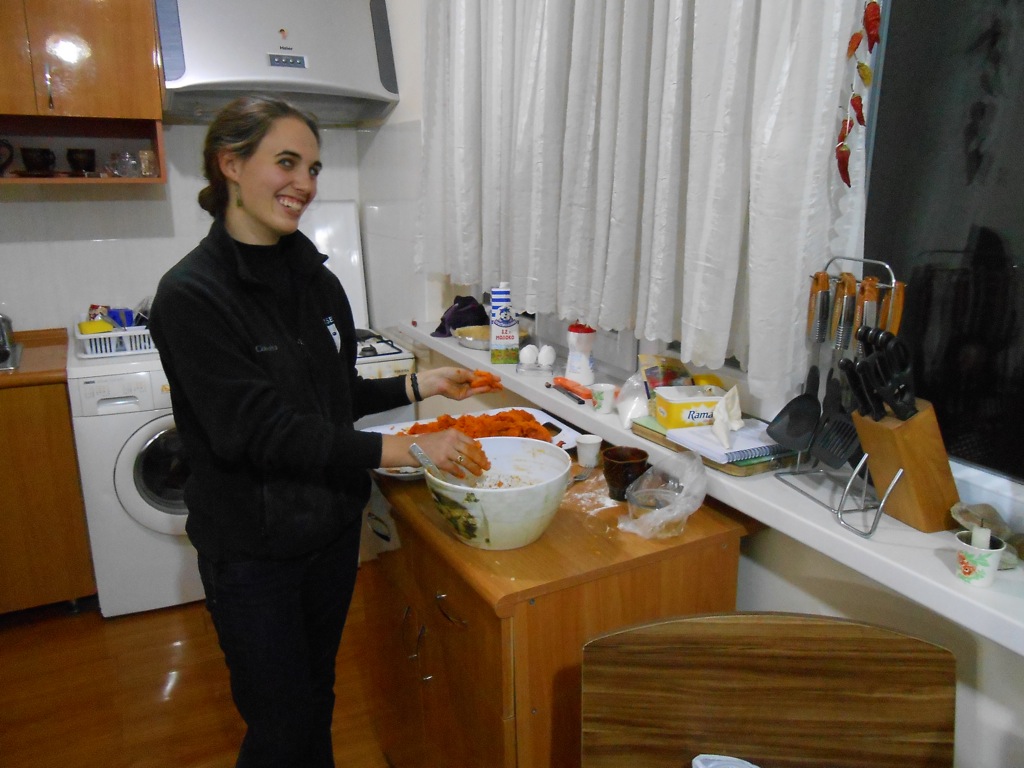
Then I ran home, where I was in the middle of cooking a turkey. I was very proud of this turkey, given my lack of experience with meat as a vegetarian for six years. We were very excited to find frozen turkeys; my friend came upon them and seized them both, since they are rare birds. We cut off the necks together in the morning, and she cooked one while I did the other. I was thankful throughout to my boss at the Embassy. She gave us the cookbook that she and her husband wrote in the Peace Corps in Ukraine, which has helpful things like how to cook a Thanksgiving turkey in a finicky oven and without access to fancy ingredients.

This is where the blog will take a turn towards photos of the cooking:

The beginning of the pumpkins.
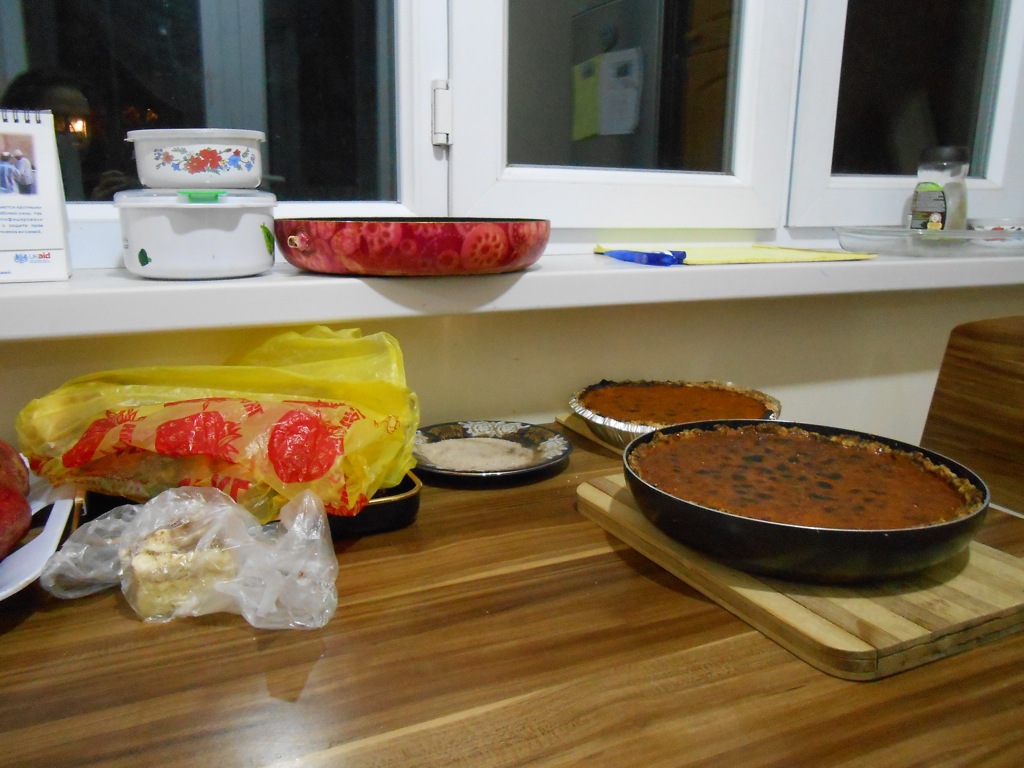
The night before, making many pumpkin pies.

To make more pie pans I had to take apart frying pans.

Note the tupperware full of roasted pumpkin seeds.

Apple pie beginning in the morning.
The final pie display.

I didn't take photos of the turkey because my hands were too covered in raw meat juice. 

Running back and forth with pies and turkey all day was good exercise for my biceps. At the end of the cooking, we ended up piling into a taxi to take it to the home of the dinner. 

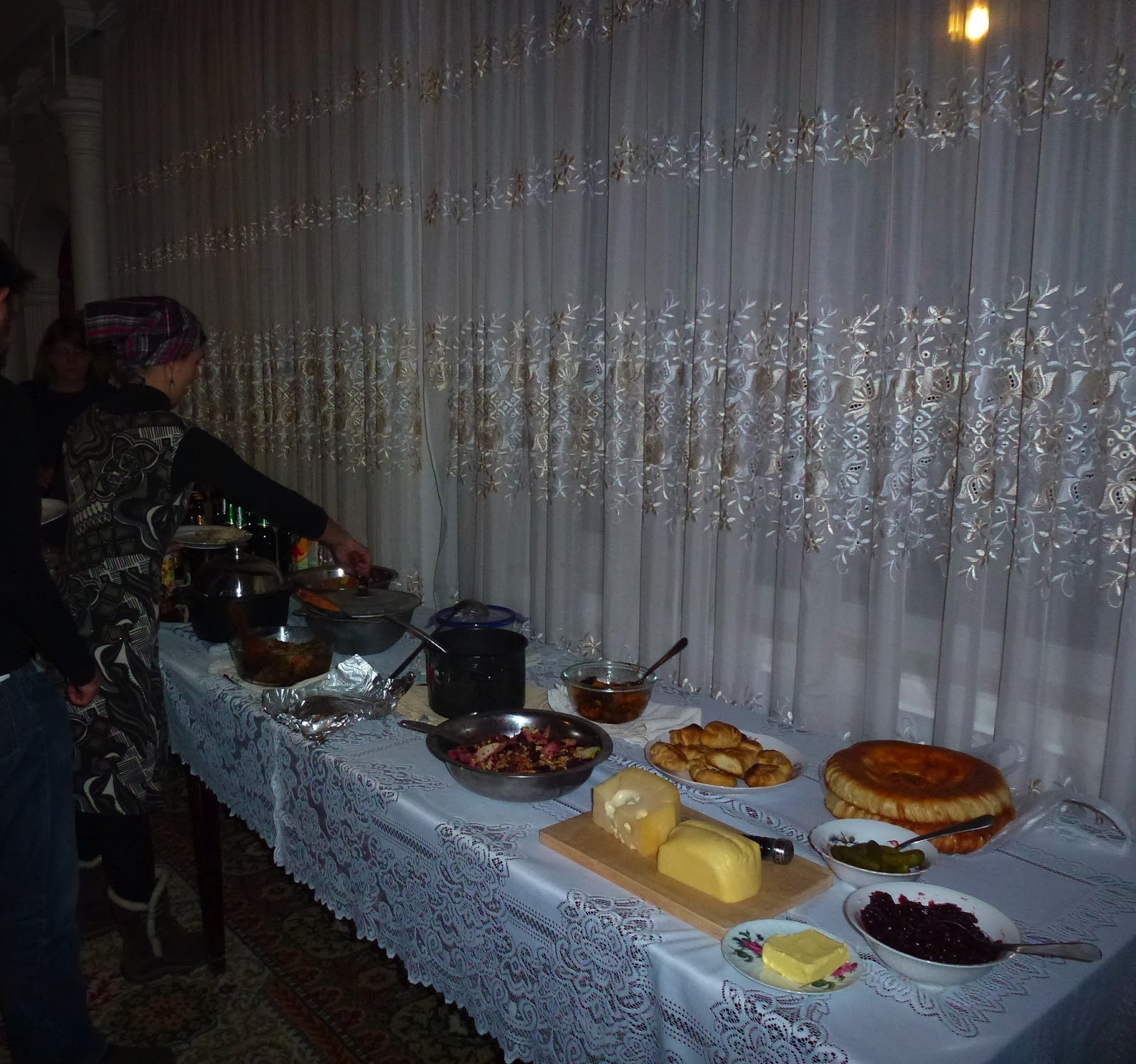
Serving myself from our buffet.

Finishing the gravy in the other kitchen.


Our meal included mashed potatoes, cranberry sauce (imported from America via a Canadian living in Bishkek's boyfriend), salads, mulled wine, and Canadian Beaver Tails along with the pies for dessert. Our feast fed fifteen people: 5 Brits, 4 Americans, 2 Canadians, 2 Tajiks, 1 Austrian and 1 German. Sara was particularly excited that one of the Canadians was a real Mountie. I inflicted the non-Americans with a dramatic re-telling of the Thanksgiving story (though they were lucky, because Sarah and I considered making them do a play). We went home at the end of the night exceedingly thankful, and happy to have celebrated in style.